
Three Sisters Cocoa Snapz rice cereal – product review

Introduction
I like to eat cereal every morning with my family before I go to work. It’s a good way to start the day especially when I can’t always predict when I’ll have time for lunch. To keep things from getting boring, we try to change up the cereal every few days to something different.
I had reviewed Three Sister’s Honey Puffs rice cereal in a previous blog entry (see first reference below), and I decided to try out another of their cereals. As you’ll soon find out, these two cereals have a great deal in common.
This cereal is pretty much a “healthy” version of Kellogg’s Cocoa Krispies, meaning its supposed to be healthy though in some ways it isn’t much different.
Flavor
This cereal is made of puffed rice, made with a similar process as puffed wheat in Honey Puffs. This gives it a light fluffy texture, and the added advantage of higher surface area without too much volume. In other words, you are eating a lot of air, and as a result you take in less calories, sugar, and nutrients (per spoonful) that you would otherwise if it wasn’t puffed. You could call this a health food in that sense (much like puffed rice cakes), but I actually think of it more as a way for the producer to save money on materials and sell a large bag of cereal with a good percentage of that empty space.
It has a moderately sweet chocolate flavor, which is appetizing but not quite what I am looking for in a cereal. The sweetness catches your intention while you are eating but sometime later you realize you really haven’t eaten that much food (at least if you eat a small bowl like I do) and are likely to get hungry earlier than if you ate a more wholesome breakfast.
Both the flavor and texture is nearly identical to Cocoa Krispies.
Nutrition / Ingredients
In a single 29 gram (3/4 cup) serving, there are 120 calories which is standard for this type of product. Sugar is 13 grams, a bit on the sweet side.
There isn’t much nutrition in this product, with no fiber, practically no protein (1 gram per serving), and less than 10% of most common vitamins and minerals. Sodium is nothing special at 150 mg, which is 6% of daily intake.
Because of the lack of substance and nutrition, I feel this is really not the best way to get your day started, unless of course you supplement it with other foods higher in nutrition.
The ingredients are so-so, with caramel color, and natural flavor as negative marks in my book. The full list is as follows:
Rice, Sugar, Coconut oil, Cocoa (process with alkali), Contains 2% less of: salt, caramel color, natural flavor, reduced iron, zinc (zinc oxide)
When comparing this to Cocoa Krispies, as you might expect both the ingredients and nutritional information is very similar. Calorie count is virtually the same (120 calories for one 31 gram serving) and sugars is actually a tad less in the “less healthy” version, at 12 grams. The other funny thing is that Cocoa Krispies has much more vitamins and minerals (compare 25% DV of vitamin A and C to 0% in Cocoa Snaps).
I remember writing something similar for the Sugar Puffs review – but I’ll repeat it here. If a cereal really wants to be billed as “healthy”, it should reduce sugar and add some more nutrients. This cereal actually has less nutrients and more sugar! (I’d like to point on here that some believe that vitamins and minerals added artificially are not easily absorbed by the body and have little to no value)
There are a few areas where Cocoa Snapz is healthier than its predecessor. Natural flavor and caramel color is used instead of malt flavor, artificial flavor, and BHT (a preservative). The last of those has particularly scary, with some research pointing to cancer-inducing effects in animal experiments. I’m not convinced it is truly harmful but if a cereal can stay fresh enough without BHT that is clearly a better way go.
Price and Availability
Available exclusively from Whole Foods. I purchased mine for $3.99. There are 396 grams in the package.
Ratings
Flavor: 7.0
Nutrition/Ingredients: 6.0
Price: 7.0
Overall: 6.66
Summary
A cereal that closely copies Cocoa Krispies flavor while making it more healthy in some areas (no preservatives) and potentially worse in others (less nutrients, slightly more sugar). If you are a fan of Krispies I recommend trying this, otherwise I would search for a heartier cereal with more nutrition.
References
https://sweetsreporter.com/2013/10/02/three-sisters-honey-puffs-product-review/
http://threesisterscereal.com/product/cocoa-snapz/
http://www.ricekrispies.com/products/cocoa-krispies-cereal
http://www.berkeleywellness.com/healthy-eating/food-safety/article/two-preservatives-avoid


Talenti Coffee Chocolate Chip Gelato- Product Review

Introduction
For Sweets Reporter’s 20th post, I didn’t want to review just any product. It had to be something extra special and extra delicious.
I decided on using Talenti’s Coffee Chocolate Chip Gelato – my current favorite ice cream, hands down. You may have noticed I just mixed terms – is this a gelato or an ice cream?
Gelato is supposed to have several major differences compared to ice cream: Less fat, higher serving temperature, more sugar, and slower churning. But this ‘gelato’ has nearly the same amount of fat, if not more, than many ice cream products. I eat it at the same temperature, and the amount of sugar is comparable to ice cream. I can’t speak on how fast it was churned, but without a clear distinction between what makes a ‘gelato’ and an ‘ice cream’, I’ll continue to group these together. After all, ‘gelato’ simply means ice cream in Italian.
Anyway, lets get to the meat of this review. I’m looking forward to writing this and I hope you are looking forward to reading it.
Flavor
This is a product that I’ve eaten so many times and just learned to enjoy in sort of a zen state. Rather than thinking about the flavor too much, I simply savor the experience as time seems to slow down. So its a little difficult to give an objective description for someone who is new to this gelato, but I’ll do my best.
From far away, things don’t look too different than run-of-the-mill chocolate ice cream. But as you dig in a spoon the texture is somehow thicker and more dense.
As I mentioned in previous posts, ice creams generally taste better when partially melted into a half-liquid state, so the creaminess can be felt along the length of the tongue. This product is no different. In fact I’d say the effect is even more pronounced, and this is in line with the recommendation that gelatos are served at a higher temperature than ice cream.
Several sensations come as your tongue makes contact with this delightful desert. There is a very strong sweetness, backed by evenly balanced flavors of chocolate and coffee. There is also a rich, savory flavor that is difficult to describe in words, but many associate with butter, meat, or cheese. On a historical note, a Japanese chemist was the first to discover this taste which he called “umami” (tastiness) and attributed to it glutamate. He was also the inventor of the (in)famous food additive MSG.
Fortunately, the savory taste in this product comes from a much more natural and healthy source, eggs. I don’t know of another gelato/ice cream with the same taste, and I think this is one of the reasons I’ve fallen for this product.
Awhile back actually tried to replicate this ice cream myself, and after a few batches with successively more eggs I realized those were what was giving such a great flavor. I never did quite get the right taste (or texture, for that matter), but I plan to try again someday.
Embedded throughout the ice cream base is a storm of chocolate pieces, little treasures hiding here and there. The company has referred to them as “a ribbon of chocolate”, but its really just tiny chocolate chips, and I enjoy their sweet, chocolate flavor much more than “chocolate flakes” I’ve had in another product.
That reminds me of a funny story. This gelato used to be called simply “Cappuccino” and lacked chocolate chips, but sometime last year they changed the name to “Coffee Chocolate Chip” and added in the chips. At that time I was outraged. I even wrote an email to Talenti demanding my Cappuccino back, and went as far as saying that the chocolate chips destroyed the smooth, creamy texture and overpowered the coffee flavor.
Now it’s over a year later and I have gotten used to these things. Having said that, I wish I could taste that classic flavor one more time. Maybe I would still like it better.
Ingredients / Nutrition
Per a single 1/2 cup (102 gram) serving, there is 240 calories. I would say this is near the average for ice creams I have eaten.
As you would expect from the taste, this product has a good helping of sugar – 24 grams per serving. While this is higher than I am normally comfortable with, because of the great taste I make an exception. There are ice creams with much high sugar content, such as Argentine Caramel, made by the same company, with 33 grams per serving.
For an ice cream with such a complex flavor the ingredient count isn’t too high (13). Eggs, which give the characteristic savory taste and also enhance the thick creamy texture, are in very high proportion (they are the 3rd ingredient). I don’t know of any other ice cream or gelato for which this can be said of.
Because of the high egg content, there is a moderate amount of protein (6 grams per serving). But more than that, the cholesterol value is off the charts, providing over half (57%) of your daily amount in a single serving. Until recently this would have been regarded as extremely unhealthy, but some recent research shows that the cholesterol in eggs can actually be good for you. See link in references section below for more information.
Besides the massive amount of eggs, the ingredients are pretty typical. My pet-peeve “natural flavor” is present, and I have sent out an email to Talenti to get further detail on what is really in there.
Here is the full ingredient list:
Milk, sugar, eggs, cream, chocolate, dextrose, oil (coconut soybean), coffee, carob gum, natural flavor, soy lechitin, vanilla.
One warning for those who aren’t frequent coffee drinkers. I don’t have any specific figures on caffeine present but based on my experience I can say there is a hefty amount in this product, coming from both coffee and chocolate. Add a sugar high to the caffeine buzz and you’ll be bouncing around for quite a while.
Price and Availability
This sells for around $5 in Publix and other grocery stores, though I have seen it for nearly $8 online. It is a bit pricey but at Publix it occasionally goes on sale for one dollar off, and rarely for half price. Whole foods also carries Talenti gelatos, but I have never seen this flavor there for some reason.
Ratings
Flavor: 9.5
Ingredients/Nutrition: 7.5
Price:7.5
Overall: 8.16
Summary
A heavenly mix of sweet chocolate and coffee, enhanced by the lush, savory taste of eggs. Except for a few minor issues such as “natural flavor” and high sugar content, its practically the perfect ice cream (or gelato). As my current favorite, I recommend it to anyone who enjoys sweets, chocolate, or coffee.
References
https://talentigelato.com/our-products/
http://en.wikipedia.org/wiki/Gelato
http://www.huffingtonpost.com/2013/05/28/ice-cream-vs-gelato_n_3333016.html
http://sweets.seriouseats.com/2012/07/whats-the-difference-between-gelato-and-ice-cream.html
http://www.livescience.com/39353-eggs-dont-deserve-bad-reputation.html

Ingredient Math – estimating worst (or best) case for ingredient proportions
Have you ever wondered how much of a certain ingredient is really present in a sweet, or any food product?
You probably know that ingredients are listed on food labels in order or prevalence, with the most predominant ingredient first. You may have even known this was determined by weight. But in this article I will discuss a method to get an estimate for the maximum of each ingredient’s percentage of total weight – just by using the ordered ingredient list.
To derive this formula, lets start with a very simple example, a product with just “coffee and sugar”. Since coffee is listed first we know it has higher or equal amount of total weight when compared to sugar.
Is there anything we can do to determine about how much the first ingredient, coffee, is really in the product? The answer is no because coffee could be almost 100% to almost 0% of the total weight, with sugar filling in the remaining space. (Actually, there is a trick to determine the amount here since the second ingredient is sugar, which I’ll discuss later in this article).
But what about the sugar?
Well, if you think about it, there can’t be more than 50% sugar, by weight, since any more of that would mean there was more sugar than coffee, which we know is not the case.
So we’ve learned something important – that there is no more than 50% sugar in the product. This would apply to another second ingredient when there are two total ingredients.
What if there were three or more total ingredients? We would get the same result, because the other ingredients could be in trace amounts (practically 0%), so the “50% maximum for the second ingredient” rule would still apply.
What about the maximum amount of the third ingredient? Using the same logic you will see it cannot be above 33.3%, since any more of that would mean it is in greater proportion than the first and second ingredients. And for the forth ingredient you get a maximum, by weight, of 25%.
Turning this into a simple formula we get the following:
Maximum percentage of the Nth ingredient = (100 / N)
So for the 5th ingredient, you would get (100 / 5) = 20% maximum weight of that ingredient.
If you use formula along with the serving size you can determine the maximum weight of any of the ingredients per serving. Pretty handy if you want to minimize your intake of certain things.
If you want to take this to the next step, you can infer more information when one more more ingredients are a type of sugar. For example, if a product contains “coffee, sugar” and has 3 grams of sugar per 15 gram serving, then you know right away there is 20% sugar and 80% coffee in this product. Keep in mind that the grams of sugar listed includes any type of sugar, so if you have multiple ingredients which contain some type of sugar (even fruits) then the calculation gets a little trickier.
Besides knowing there is a certain percentage of sugar, you can use that to deduce information about other ingredients.
For example, if the imaginary product I just described had a third ingredient, say “coffee, sugar, vanilla”, then you would know that there is 20% or less vanilla because sugar is 20% or less. This assumes that there is no sugar in the vanilla, otherwise it would be harder to make any definitive conclusions.
Similarly, if you know how much protein is in each ingredient, you can figure out even more using the supplied protein in grams.
You can also leverage information about other ingredients to deduce additional information about the other ingredients. For example if a product had “milk, sugar, guar gum, vanilla”, you would know that the proportion of vanilla is much less than 25% since guar gum is typically used in relatively small doses. (I’ve tried overusing guar gum in homemade ice cream – its not pretty!)
I love thinking about food and ingredients from a methodical, logical point of view since it allows me to apply science to my everyday life.
References

Meiji Hokkaido Azuki (Red Bean & Condensed Milk) – product review

Introduction
Last time I stopped by the neighborhood Asian grocery store I picked up Wakakusa Daifuku (a japanese sweet which was the subject of my last report), and my wife picked the product which I’ll highlight this time – Meiji’s Hokkaido Azuki ice cream bar. Meiji is a major producer of various food items – sweets, milk, juices, and soups to name a few. For those history buffs, ‘Meiji’ also represents an era in Japan from September 1868 through July 1912, where Japan’s society evolved from feudalism to a more modern structure.
Unlike the daifuku which was made in Japan, this product actually comes from a factory in Taiwan (from what looks like a Taiwanese subsidiary of Meiji called ‘Poki’), which is probably the reason for the cheaper price and some lower caliber ingredients (colorings, etc.)
Hokkaido is Japan’s second largest island, situated in the north, and it’s actually depicted on the package. I discovered that Azuki beans are in fact produced there, but I haven’t been able to verify if those used in this product are officially Hokkaido Azuki beans.
Flavor
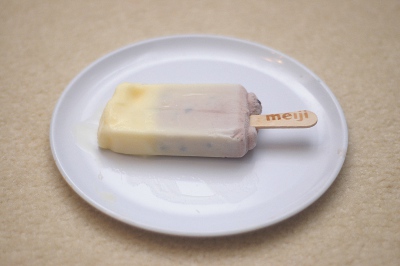
This ice cream bar has a azuki bean core surrounded by a milk coating, painted on very thin except near the tip where there is nearly an inch of solid coating. My sweet-tooth instincts compelled me to bite here first, and I was rewarded handsomely with a lusciously thick, creamy flavor, sweet but not overly so. The tip’s shape was deformed, likely a result of partial melting and re-freezing, but I got over this quirk immediately. I’ve attached a picture at the bottom of this article.
In the core, beans have been used in both whole bean and paste form. Unlike some azuki-based deserts which are overloaded by sugar, this one has a very mild sweetness which doesn’t overpower the strong, earthy azuki bean flavor. The rough texture here strikes an excellent balance with the outer coating’s creaminess. I was impressed by the surprising number of beans packed in, similar to the picture on the box.
Personally I’m not very found of ice cream bars where a wooden stick, serving as a handle, is submerged partway through. The first few bites are great, but as I get closer to the stick I have to bite carefully which takes away from the enjoyment. Neither the texture nor the flavor of wood fits with ice cream so accidental bites are unpleasant indeed.
Nutrition & Ingredients
Each box contains four bars, and each bar is 100g (1 serving). There isn’t a great deal of nutrition in this bar, with protein and fiber only 2 grams and 1 grams, respectively. There is also no trace of common vitamins such as A and C.
What really shines about this product is two of the most important nutrition metrics (to me, at least): calories and sugar content. In a single serving there is an below average amount of calories per serving size – only 173. But what’s even more amazing is the sugar content – only 5 grams! That’s the lowest I have seen in a product of this type and as a seeker of low-sugar sweets it really impresses me. I’m confounded on how they managed to create such a sweet flavor from only 5 grams of sugar, especially in the sugary milk coating.
One of the secrets of creating a low calorie, low sugar desert is to use water as a base, and that is done here with water as the most prevalent ingredient. Many of the top few ingredients are healthy and natural – milk powder, red beans, and coconut oil. Maltose, a sugar produced from grain and known by the name ‘malt sugar’, is used in higher proportion than normal sugar.
As you get to the less prevalent ingredients you start to run into “Natural Flavors” as well three artificial food colorings. These are disliked by the many of the health conscious, and for good reason. As an example, the blue coloring used is made from petroleum and is one of the dyes suspected of causing cancer (see link in references below for more info). Though legal in most countries, in the past it had been banned in over 10 countries. As a health skeptic, I’m more likely to believe that companies lobbied to get this legalized as opposed to researchers suddenly “discovering” they were not bad for health.
Besides the health angle, I think the colors themselves are a bit strange (as well as quite different from those used on the package), and would like to see how things look without any colorings. I’m sure it would still be appetizing and much better for the body.
The full ingredient list is: Water, Skimmed Milk Powder, Red Bean, Butter, Coconut Oil, Maltose, Sugar, Emulsifier, Salt, Nature [sic] flavor, Caramel, FD&C Yellow #5, FD&C Red #20, FD&C Blue #1
[Update: Because many Japanese characters are derived from Chinese, I was able to partially read some of the original ingredients and nutrition information. First thing I noticed is that the order of ingredients is different. In the English translation some of the sugar-related ones are shown to be less prevalent. Also, the sugar content didn’t seem to be listed in the original ingredients. Without further research I can’t say definitely, but there is a chance the English translation is incorrect.]
Price and Availability
I purchased this at a local asian grocery store for around $3. I plan to verify the exact price next time I stop by there and update this blog.
Ratings
Nutrition & Ingredients: 6.5
Flavor: 8.5
Price:7.0
Overall: 7.33
Summary
A superb mix of azuki beans and sweet milk, made with mostly natural ingredients and very low sugar. The main drawback is the presence of unknown natural flavors and the dreaded artificial food colorings.
References
http://www.poki-meiji.com.tw/product-detail.aspx?id=469
http://en.wikipedia.org/wiki/Meiji_period
http://en.wikipedia.org/wiki/Brilliant_Blue_FCF
http://www.doctoroz.com/videos/food-dyes-are-they-safe

Wakakusa Daifuku (若草大福) – Japanese sweet candy (product review)
Introduction
As a I did research for each of my sweets reports, I discovered that there are a huge amount of other blogs reviewing many of the same products. That it itself isn’t a major surprise, but it got me thinking that if I really want to distinguish myself from other blogs, I need to work hard on not only top-quality, detailed reviews, but also on targeting new products or those that are not as popular yet in the mainstream.
My product selection this time, a Japanese confection from Adachi Sangyo, is an attempt to introduce a niche product to a wider audience. I’m hoping that those unfamiliar with ‘daifuku’ will be happy to learn about one more way to indulge in your craving for sweets.
Food products from other countries are always interesting. Not only do you get a unique flavor not found in everyday American foods, but you also get a unique set of ingredients that has potentially to be different, if not healthier, than typical ingredients used in domestic foods.
Nutrients / Ingredients
So what is a ‘daifuku’ anyway? It’s a traditional Japanese sweet existing for over two centuries which consists of a sweetened red bean paste (anko) wrapped by a layer of glutinous rice cake (mochi). They are in flattened sphere form, and these daifuku are small enough to fit in the circle made by my thumb and forefinger.
One bag contains 7 daifuku and each one is 16 grams (1 serving). Each serving is only 50 calories, but that hides the fact that over 80% of this product (13 grams) is sugar. The first two ingredients are sugar and starch syrup, the latter being made in a process similar to corn syrup where starch is converted to syrup. If that didn’t make you run screaming then the rest of the story isn’t quite as bad.
This product is pretty nutritionally barren, in both a positive and negative sense: no sodium, no fat, no protein, and no fiber.
The great thing is that the 3rd, 4th, and 5th ingredients are all made natural plants or grains – rice, red beans, and mugwort. The latter is a flowering herb whose extracts have been shown to inhibit a certain type of cancer cells in vitro. The name ‘Wakakusa’ means something like ‘young plant’ and refers to this Japanese mugwort (yomogi).
The package I bought contained an English translation of the ingredients and nutritional information along with the original text in Japanese. I was surprised to find that the original contained two ingredients not found in the English translation: coloring (Safflower and common gardenia ) and “flavoring”. I’m glad they decided to use natural coloring agents, but very nonplussed about the mysterious “flavoring”. Translation of this word (香料 “kouryou”)says it can refer to both natural and artificial flavoring.
Oddly, I couldn’t find the calorie count listed in the original Japanese text. Because of the omission with some ingredients in the translation I’m suspicious about this number.
Here is the full list of ingredients:
Sugar, starch syrup, rice cake powder, red bean paste, (japanese) mugwort, starch, trehalose, skim milk powder, antioxidant (vitamin e), coloring (from flowers), flavoring.
One interesting ingredient used here is ‘trehalose’, a sweetener that is roughly 45 percent as sweet as sucrose and a low insulin response. It has the nickname ‘mushroom sugar’ because it can be found in some mushrooms. I believe it is used here primary as a preservative since it is present in only a small amount.
Vitamin E is also used as a preservative to prevent oxidation and keep the food fresher. But for a product that is sold in a refrigerated section this seems unnecessary. Vitamin or not, I’d prefer less preservatives in my food.
Overall, the use of natural ingredients such a rice, beans, and mugwort are a great idea, but the extreme amount of sugar renders them practically useless from a nutritional point of view.
Flavor
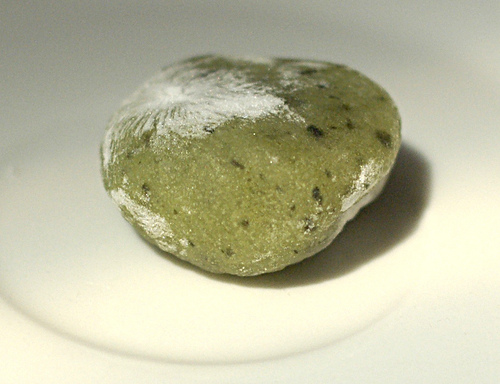
Besides the light green color mixed with darker green colored spots, you’ll notice a fine powder covering the outside of each daifuku. This is most likely rice cake powder (or another type of flour) and is used to keep the confection from sticking to the little plastic wrapper containing it.
As you pick up one of the little daifuku, you’ll notice it has a gummy texture, and when you bite into it you are taken captive by the sticky, chewy sensation. That is the glutinous rice. Besides a moderate sweetness I don’t detect any other strong flavor in it.
When you reach its core there is a burst of extreme sweetness, as well as coldness, as your tongue savors the dark red azuki paste with its smooth texture. The contrast between the filling and the outer core is quite well balanced and keeps your senses busy.
I’m very familiar with azuki beans to the extent that I have made my own paste, so I quickly picked up on the subtle, but distinctive bean flavor of the filling. However, those less accustomed to this might just only perceive it as an ‘earthy’ taste. It doesn’t really taste like other beans (black, pinto, etc.), though the mashed texture is not too different.
Ironically, the mugwort (which the product was named after) didn’t have a strong taste. I had the sensation of eating flowers/plants but with my a priori knowledge of the ingredients its hard to give an unbiased description of the flavor. For my future reports I’m considering eating the product before reading though the ingredients so I can have a more neutral impression.
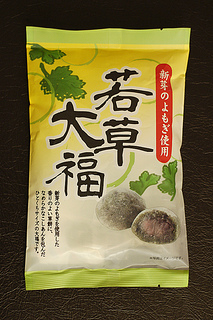
As a side note, the packaging is very artistic and feels like more effort was put into designing it that many American sweets.
Price and Availability
I found these at a asian grocery store in south florida, and odds are you can find it at a similar place in your neighborhood.
Since these are somewhat of a specialty imported item, they are not cheap. For a bag of 7 the price is around $3-$4. I apologize for not keeping track of the exact price, I’ll check it next time I return to the store and update this entry.
You could probably buy it online but as an imported good the shipping would probably make it prohibitively expensive.
Ratings
Flavor: 7.0
Nutrients/Ingredients: 5.0
Price: 6.0
Overall: 6.0
Summary
Great entry point into the world of exotic Japanese sweets, although the natural ingredients employed are offset by a load of sugar.
References
http://www.adachisangyo.co.jp/syohin/daifuku/index10.html
http://en.wikipedia.org/wiki/Artemisia_princeps
http://en.wikipedia.org/wiki/Daifuku
http://ja.wikipedia.org/wiki/%E3%83%99%E3%83%8B%E3%83%90%E3%83%8A
http://ja.wikipedia.org/wiki/%E3%82%AF%E3%83%81%E3%83%8A%E3%82%B7
http://www.caloriecontrol.org/sweeteners-and-lite/sugar-substitutes/other-sweeteners/trehalose

Luna & Larry’s Coconut Bliss Mint Galactica ice cream – Product Review
Introduction
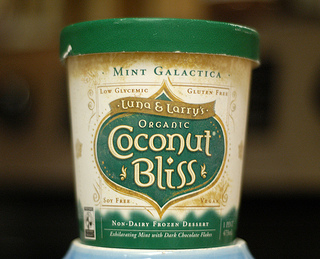
This is my second product report of a Luna & Larry’s Coconut Bliss product, the first being of Chocolate Walnut Brownie flavor. I’m a big fan of that ice cream so I thought I would experiment with another flavor.
I’ve had my share of mint ice creams: Bryer’s mint chocolate chip was one of my favorites as a boy, and recently I’ve enjoyed Talenti’s Mediterranean Mint on a handful of occasions.
I was won over by this product’s great name (could it be because I’m a fan of Science Fiction?), even before I tossed the pint into my shopping cart. If I gave a rating for naming, I would surely give this a 10/10.
Flavor
The base cream has a strong coconut flavor, more so than other makers’ coconut ice cream I’ve tasted, and the mint is very much in-your-face. These two flavors mesh well and make a great foundation for an excellent taste experience.
But this ice cream falls short to deliver a strong counterpoint which serves as a contrast, like a picture with a well defined foreground and background. In my previous review, there was a nice contrast between the sweet chocolate coating and the (somewhat) crunchy cookie part.
The chocolate flakes are supposed to serve that role, but until I ate this I didn’t realize the true difference between ‘flakes’ and ‘chips’. Chips are cube shaped and flakes are, well, similar to well-known corn flakes where they have a large, irregular surface area, but are extremely thin. My problem with this shape is that they appear large and tasty, but when you taste them there is practically no substance. As a result they don’t influence texture or taste much. I included a close-up picture of the flakes at the bottom of this post for reference.
After several servings of this I might get used to these flakes and understand their contribution better, but at present I just feel like there this product is just too hollow and lacking depth.
Another minor disappointment is that this ice cream is white, not colored green like some other mint-flavored creams. Of course I’m against using artificial colorings, but apart from that I feel the color has a psychological effect of emphasizing the mint flavor and making it taste all the more refreshing. To me, plain white signifies vanilla, which is at odds with the actual flavor here.
Don’t get me wrong – I’m not trying to say this coconut ice cream is that bad, its just that when compared to similar products it falls short. In fact, I am enjoying eating it while writing this report.
Nutrition / Ingredients
A 1/2 cup serving (97 grams) contains 15 grams of sugar, below average for ice creams, and 240 calories which also on the low side. There are 3 grams of fiber and 2 of protein.
Nutritionally this ice cream is very similar to the previously reviewed Chocolate Walnut Brownie, except that here we have much less Iron (4% vs 15% DV), one-fifth the salt (10mg vs 55mg), and a few other minor differences.
The base ingredients are also similar between these two products, and everything is organic. Of course there are no brownies or walnuts, which have been replaced by peppermint extract and coconut cream, the latter being an ingredient I haven’t seen used before. The chocolate here is in flake form as opposed to be mixed into the cream itself.
I have been researching the health effects on various types of sugar, and apparently some professionals believe that agave isn’t especially good for the body. The high amount of fructose contained in agave makes it resemble the dreaded “high-fructose corn syrup”. I plan on doing some more research on this critical topic and eventually would like to write a detailed post with my results, but for now I’ll just say that there is disagreement on how healthy each type of sugar really is. I personally still prefer agave to standard sugar, but because of the uncertainty I’ve reduced my ingredients/nutrition rating of this product from 8.5 to 8.0.
Price and Availability
This typically sells for around $6.49 with tax. This a bit pricey for those on a budget, but not unexpected, considering this is a non-dairy specialty product.
There a only a few places that I know of in South Florida that sell this, one is Whole Foods Market which is where it happened to be on sale for roughly one dollar cheaper.
Ratings
Flavor:6.0
Nutrition/Ingredients: 8.0
Price: 6.0
Overall: 6.6
Summary
Nice healthy ice cream with natural ingredients, but the flavor may be a little underwhelming for those who are used to other mint creams.
References
http://coconutbliss.com/coconut-bliss-products/mint-galactica
http://www.webmd.com/diet/features/the-truth-about-agave

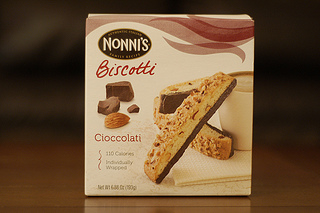
Nonni’s Biscotti Cioccolati
Introduction
I’ll admin I’m pretty new to the world of biscotti. I’ve known about this italian cookie (whose name originated from a Latin word that means “twice cooked/baked”) for many years now, but my first opportunity to try one was when we decided to buy one for our son. That was a different product that was sold in single packages, but since he enjoyed it so much we searched for a healthier product. Nonni’s Biscotti Cioccolati is what we ended up discovering.
As you likely already guessed, “Cioccolati” means “Chocolate” in Italian.
Flavor
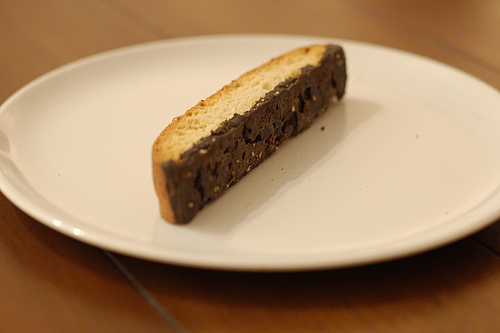
As is typical of biscotti, these are elongated, finger shaped cookies. Nuts adorn one side and a strip of chocolate the other. While both almonds and walnuts are used according to the ingredients list, the nuts were so finely chopped and so sparse that they practically had no effect on the overall texture or taste. This contrasted greatly with the picture on the box (shown above) where the nut size, amount, and placement was much more favorable. I checked the few cookies remaining in the package and some of those looked better than the ones I had eaten, but none looked quite as good as the product photograph.
I had two of these cookies before writing this report, and one of them was much crisper and firmer than the other, more what I would expect from a twice-baked product. I’m not sure what happened to the spongy one. Maybe there was a small hole in the packaging which let air in and accelerated staleness. If you are accustomed to super-crispy biscotti, you might be disappointed with this product.
The mildly sweet cookie base, whose flavor brings to mind a cake, is balanced by a sweet, thick layer of chocolate. This was the most generous helping of chocolate I’ve experienced on a Biscotti, and as a result I I don’t think I’ll ever to be enjoy other brands with less chocolate the same.
There was a minor aftertaste which bothered me, or should I say undertaste since it sort of hid underneath the basic flavors. I don’t think it is inherently bad, but it somehow reminded me of another food product which was unhealthy. I can’t quite put my finger on what it is though.
Ingredients / Nutrition
A single cookie has 110 calories and 9 grams of sugar. For a fairly large cookie whose length is about a inch longer than my middle finger, those aren’t bad figures. Most people will tend to nibble a little at a time, so one cookie can go a long way in terms of time and enjoyment.
Theres not much to write home about regarding nutrition, with 2 grams of protein, 1 of fiber, and 4% or Iron. Clearly this cookie wasn’t made to replace a meal but nobody’s trying to pretend it does.
There are around 20 ingredients which isn’t too bad for this type of product. You can compare to my recent review of Ben & Jerry’s Chocolate Brownie ice cream, which had nearly the same number. There are no artificial flavors, and real vanilla is used instead of the artificial vanillin, which is a nice touch. There is the mysterious “natural flavors” but thats pretty common practice for this type of product. The rest of the ingredients are pretty much standard-fare, with the exception of anise seeds which raised an eyebrow. I’m guessing they use it to improve texture.
As a side note, Nonni’s logo contains the phrase “Authentic Italian Family Recipe” and their website claims they have been using the same recipe for almost a century. However I somewhat doubt that chocolate was used back then, at least in such a large proportion. In any case, the cookie base seems like it might very well be authentic, but I’m no biscotti expert.
Also its interesting to note that their website claims they are the most popular selling biscotti on the market. Aside from the minor texture inconsistency, I’m not surprised.
Price and Availability
I got mine at Publix for around $3.00 for a 8-pack. These are also available online at places like Amazon. For less than 50 cents a cookie, they are a great deal! I called my local Whole Foods and they didn’t carry this product, unfortunately.
Ratings
Flavor: 8.0
Ingredients/Nutrition: 7.0
Price:8.0
Overall: 7.66
Summary
Great tasting biscotti cookie with reasonably natural ingredients and a sweet coating of chocolate. It’s not going to win any awards for nutrition, but its a must-try for fans of biscotti or Italian food.
References
http://nonnis.com/products/cioccolati/

Ben & Jerry’s Chocolate Fudge Brownie Ice Cream – Product Review

Introduction
In my college days, Ben & Jerry’s Chocolate Fudge Brownie was my go-to ice cream when I had a rough week or had accomplished something noteworthy and deserved a reward. Though I would never attempt this at my age, in those days I would just sit down and polish off an entire carton in a matter of minutes.
I generally try to gravitate towards less sweet products, but there was a half price sale at Publix so I had an excuse to pick up a pint of this.
In spite of my nostalgic attachment to this product, I’ll do my best for an unbiased review.
Flavor
This ice cream is about as sweet, rich, and decadent as you can get. As you come across the brownie pieces, your teeth sink into spongy cake with an even deeper sweetness (if that is even possible). When I eat this my “avoid too much sugar” angel on my shoulder has to keep quiet or else I can’t enjoy myself.
I love how the base ice cream itself is so thick and gooey. It would work fine on its own even without the brownie bites inserted.
This ice cream also tastes colder on the tongue than most others I have tasted, possibly because it is so dense an can hold a low temperature better than others. One reason for this is a high concentration of water.
Ingredients & Nutrition
A 105 g serving (1/4 of the container) contains 270 calories, which is significantly above average for the ice creams I typically enjoy.
I’ll just let the cat out of the bag – Chocolate Fudge ice cream contains way more sugar than anyone health-conscious would ever consider consuming, a whopping 28 grams per serving. But the fact this ice cream is so bad for you is what makes it so tasty, and why it’s perfect for special occasions when you feel you deserve it. Just make sure you eat no more than half of the carton at a time!
Other nutrients are mediocre, with 5 grams protein, 2 grams fiber, 15% DV of iron and 10 %DV of calcium.
There are around 20 ingredients, which is no surprise because typically brownies require several ingredients on their own. Also, this product isn’t marketed as a healthy ice cream so there’s no reason for the producer to try and reduce the ingredient count. Ingredients of note are liquid sugar (#2), water (#4), and cocoa (#6). There is also three egg ingredients (egg yolks, whole eggs, and egg whites) present.
While Ben & Jerry didn’t go out of their way to use ingredients thought to be ‘healthier’ such as agave syrup instead of plain sugar, its nice to see there are no artificial flavorings or colorings. There is no ‘natural flavor’ either.
One minor annoyance I have with this product is the ingredients for the base ice cream and brownie bites are not separated as is done for other products. I have a feeling the thick texture of the ice cream base is due in part to egg yolks, but I can’t tell for sure since eggs are also typically used in brownie baking.
The brownie bytes make this ice cream very filling so it can be enjoyed even when you’re hungry. Regardless of the state of your stomach, you’ll get a huge sugar rush after this.
Price and Availability
This is available in many different grocery stores, from Publix to Target to Walmart, for roughly $3.79 for a one pint container.
Ratings
Flavor: 9.0
Ingredients&Nutrition: 6.0
Price: 8.0
Overall: 7.66
Summary
This ice cream is perfect for when you want to go overboard and just totally enjoy yourself – at the cost of a massive amount of sugar intake. Not recommend for frequent consumption.
References

You pick the (sweet) food. I report on it.

Now that I’ve done a series of reports on various sweets I’m familiar with, I think its time to ask the community what products they want reviewed.
Curious about that new ice cream thats a little pricey? Want to know how good a certain cookie is nutritionally? Or looking for how a certain brownie stacks up against its competitors?
Just leave a comment here with the product name. Assuming I can acquire it somewhere locally, I’ll do my best to report on all responses I get, including information about flavor, nutrition, price, and in some cases I’ll contact the producer for more information on an ingredient or the like. Or if you don’t have a specific product name, but are looking for something (“Whats the best XXX you recommend?”) let me know as well.
Looking forward to hearing from everyone!

Three Sisters Honey Puffs – Product Review


Introduction
Sugar.
I live a conflicted life – I yearn for sweet treats while simultaneously scrutinizing them for sugar content. Sugar is also the topic of this blog, albeit indirectly.
As I studied my sugar intake I began to realize there is enormous amounts of it in some unexpected places, especially in breakfast foods. Everyone knows donuts are quite sugary, but when you turn a careful eye to other foods such as yogurts, and even many cereals, the sugar really comes out of the woodwork.
Our product this time is in that very category, a strongly sweetened breakfast cereal made by Three Sisters company (not to be confused with “Three Twins”, the ice cream producer). A great thing about this company is that they purchase wind-generated credits proportional to the electricity used to make their cereals, a nice aid to sustainable energy.
Flavor
This cereal is made of sweetened wheat grains, puffed with heat in a process much like popcorn. Both flavor and composition is very similar to Post’s Super Golden Crisp, which it’s clearly modeled after.
I think you probably already saw this coming, but the sweetness is a little too heavy for my taste, especially when eating this as my first meal of the day. The puffy texture is pleasant, but it seems a tad airier than Post’s classic cereal, at least as far as I can remember.
If the overt sweetness doesn’t bother you, you will likely find this cereal quite delicious. My young son loves this and eats it up, sometimes asking for seconds.
Ingredients / Nutrition
One serving (27 grams or ¾ cup) contains only 110 calories, a typical value for cereals. Unfortunately sugar clocks in at a whopping 15 grams. Sure, if you only have one serving this isn’t a massive amount, but the amount of sugar per weight is very high, surpassing many ice creams!
With minor amounts of minerals, this product is nutritionally unimpressive, with only 2 grams of protein and zero fiber. There is low salt (65 mg), and no fat or cholesterol, but that doesn’t make up for the lack of nutrition.
Ingredient composition isn’t anything special either. Here is the full list:
Sugar, Wheat, Corn Syrup, Honey, salt, Caramel Color, Soy Lechitin, Citric Acid, and Sodium Acetate.
Three out of four of the top ingredients are used for sweetness. With a name like “Honey Puffs” you would expect honey to be the most prevalent, but instead its disappointingly last, and thereby in a much lower proportion that the other sweeteners. Corn Syrup, while not nearly as bad as its evil brother High Fructose Corn Syrup, is nevertheless made from processed corn and something I think we all have had too much of in our diets.
Caramel Color is another undesirable item which I discussed in one of my recent posts. Effects on the body vary depending on the process used but coloring is never a plus unless its from something completely natural.
Sodium Acetate is a common flavoring agent (it gives the characteristic taste to salt and vinegar chips), which supposedly has no major health drawbacks. Having said that, I prefer they would use something a bit more natural, like plain old salt.
Above all my biggest problem with this cereal is that it isn’t much different than the classic cereal it is clearly based off, Post’s Super Golden Crisp. Ingredients are very similar, though there are some minor tradeoffs like less salt (40 mg) and non-zero fat (.5 g). To make matters worse, Honey Puffs actually has *more* sugar than Super Golden Crisp. Give me a break!
I think making a healthy version of a not-so-healthy classic is a great idea, but I wish they would set themselves apart by a wider margin.
Price and Availability
Available exclusively from Whole Foods. I purchased mine for $3.99, though recently they had a sale for buy one get one free.
Ratings
Flavor:6.5
Ingredients/Nutrition:5.0
Price:7.0
Overall:6.2
Summary
Cereal with too much sugar and not enough nutrients to make a well-balanced breakfast.
Related Products
I recommend the Honey Oaties cereal from the same company, which contains more fiber and much less sugar.
References


 Sweets Reporter