Blog Archives

Ingredient Math: Calculating minimum ingredient proportions

In a previous article here, I showed how to calculate the maximum proportion of a ingredient listed on a food label. I derived the following simple formula:
Maximum percentage of the Nth ingredient = (100 / N)
This time I’ll use similar logic to derive a formula for the minimum amount of an ingredient, based on only its order in the listing and the total number of ingredients.
Let’s start with the simple case of a product with two ingredients: “sugar, cocoa”.
With a little thought, we can see that sugar cannot be any less than 50%. If it was, then cocoa would have to be greater than 50% (since it equals 100% – sugar) and that is impossible based on the ordering rule that the most prominent ingredients, by weight, are listed first.
What about cocoa? Clearly it has no minimum since it could be 0.00001%, leaving the remaining 99.9999% to sugar.
Next let’s try a product with three ingredients: “sugar, cocoa, shredded coconut”.
Using similar logic, we will see the minimum amount of sugar is 33%, since any less than that would mean the other ingredients would have to have a higher proportion than sugar. If we assumed sugar was 20%, then the other two ingredients must add up to 80%, and therefore one of them must be present in at least 40% proportion – but that is greater than sugar which is listed first!
And the second ingredient? Just like the second ingredient in the two-ingredient example, this can be arbitrarily small. For example: 99.9% sugar, 0.09% cocoa, and 0.01% shredded coconut.
To generalize these results:
Minimum percentage of the 1st ingredient = (100 / T), where T is the number of total ingredients
Minimum percentage of the other ingredients = infinitesimally close to zero
As with the calculations of maximum proportion in my previous article, if we have additional information about the other ingredients we can use that to determine the minimum level of the other ingredients. For the same example, if we sifted and then weighed the shredded coconut (third ingredient), we could determine its overall proportion by weight. Lets say this is 10%. Then we could reason that cocoa, the second ingredient, takes up a minimum of 10% total weight since it must be equal or greater to the amount of shredded coconut. From this we could also conclude sugar (the first ingredient) is at most 80% of the total weight.
You can use nutritional values such as protein and fiber to infer how much of certain ingredients are present, especially if those have a large proportion of a certain element.
You may feel that this sort of calculation may seem unlikely to have any practical use, but if you find yourself saying “I eat so-and-so product because it contains a large amount of X, which is healthy”, then you can use it to see the minimum level of that ingredient you are consuming.
Another use is if you are trying to make a homemade version of something and you want to get a feel for the minimum and maximum amount of it in the product.

Product Review: Ben & Jerry’s Frozen Yogurt Chocolate Fudge Brownie

This ice cream is from the “FroYo” series which takes popular Ben & Jerry’s flavors and turns them into frozen yogurt with reduced calories and fat. I had reviewed the ice cream (non lowfat) version of Chocolate Fudge Brownie here, and this time I thought I would review the lowfat one. It’s great when you want a deep, rich flavor without quite as many calories.
Flavor
This dessert tastes very similar to the ice cream version. Spongy brownie pieces float in a sea of rich, gooey chocolate, saturated with sugary goodness throughout.
I’m sure if did a direct taste comparison where I alternated between spoonfuls of these two products I would be able to taste the difference more clearly, but eating it normally the FroYo doesn’t taste anything like “low-calorie” or “low-fat” – which is a good thing. The main difference is that the texture is more icey and less creamy. It’s midway in between eating normal ice cream and Italian ice (the latter of which has no milk and only water as its base).
The first time I tried this I didn’t taste any of the yogurt flavor. I tried it again, paying close attention, and was able to detect yogurt very subtly, more as an aftertaste than anything else. More on this below.
Nutrition/Ingredients
For a single 104 gram serving there is 180 calories, slightly below average for an ice cream of this type. Consistent with the “lowfat” branding, there is only 2.5 grams of fat. Compare these figures to the normal Chocolate Fudge Brownie – 270 calories and 12 grams of fat – and you’ll see a huge difference.
For those of you who are more concerned about sugar intake than calories (which I sometimes am), this product isn’t too great. There is a whopping 25 grams of sugar, only 2 grams less than the standard less-healthy version. I’d wish they would have reduced it a bit more, but I guess the characteristic flavor would be ruined if they took out any more sugar.
Protein amount is typical at 5 grams, and fiber is 2 grams a serving.
As I mentioned above, this product has only a tiny hint of yogurt taste. I checked on what “frozen yogurt” really means, and it looks like besides containing yogurt, it is also typically more tart, and lower in fat due to milk used in place of cream. Comparing ingredients against the normal ice cream version, we can see that both contain skim milk and cream. However the FroYo version contains more skim milk than cream (order on label 2nd and 9th, compared to 3rd and 1st on the ice cream version). So this frozen yogurt does contain less fat, although it is not particularly tart.
Technically this product can be placed in the “frozen yogurt” category because of the presence of yogurt powder (11th place) and yogurt cultures (20th and last place). However, because of the small amount of these ingredients, which is reflected in the taste, I wouldn’t really consider this a true “frozen yogurt”. It looks like Ben & Jerry’s is just using the “yogurt” nomenclature to associate nutrition and health, and as a result sell better. I can’t say whether the yogurt cultures have any nutritional benefit or not, but they in are such small proportion I doubt that is much an effect, if at all. I’d prefer B&J’s either drop the yogurt branding and remove the little yogurt that is present, or increase it so this dessert can honestly be called a “frozen yogurt”.
Another trick they use to make this product lighter is using water as a filler – it’s listed as the #1 ingredient and is the main reason for the texture change I discussed previously. I think this is generally a great idea for health-conscious frozen desserts, and when done in moderation doesn’t destroy the flavor.
I’ve listed both versions’ ingredient list below. If you compare you’ll see that except for the yogurt, milk/cream, and water differences, they are very similar.
FroYo version (this product):
Water, Skim Milk, Liquid Sugar (Sugar, Water), Corn Syrup, Sugar, Cocoa (Processed With Alkali), Wheat Flour, Corn Syrup Solids, Cream, Cocoa, Nonfat Yogurt Powder, Egg Yolks, Butter (Cream, Salt), Eggs, Egg Whites, Locust Bean Gum, Salt, Vanilla Extract, Sodium Bicarbonate, Yogurt Cultures
ice cream version:
CREAM, LIQUID SUGAR (SUGAR, WATER), SKIM MILK, WATER, SUGAR, COCOA (PROCESSED WITH ALKALI), WHEAT FLOUR, COCOA POWDER, EGG YOLKS, BUTTER (CREAM, SALT), INVERT SUGAR SYRUP, WHOLE EGGS, EGG WHITES, GUAR GUM, SALT, CARRAGEENAN, VANILLA EXTRACT, MALTED BARLEY FLOUR, SODIUM BICARBONATE.
One final difference is that the FroYo version does not contain carrageenan, a substance used as a thickener/stabilizer. It turns out there is some research that indicates carrageenan may be involved in tumor promotion, though I don’t think there is any definitive proof for this yet, and currently it is considered as a safe food additive by the FDA. Nevertheless I’d rather do without it if I have a choice.
Price/Availability
This product is available all over the place. I purchased it for $4.69 at Publix supermarket.
Ratings: Flavor: 8.0 Nutrition/Ingredients:7.0 Price:8.0 Overall: 7.6
Summary
This doesn’t stand out as a particularly healthy choice, but when compared against the less healthy non-yogurt version it’s much lower in calories and fat, and still boasts a rich, sweet taste. Once you switch to FroYo I doubt you’ll find the need to return to more fattening ice cream.
References
http://www.benjerry.com/flavors/our-flavors#product_id=650
http://www.benjerry.com/flavors/our-flavors#product_id=611

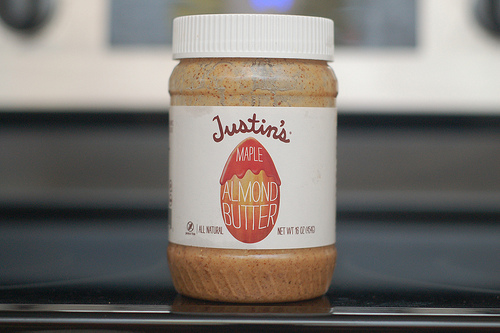
Product Review: Justin’s Maple Almond Butter Spread
Introduction
I’m a heavy consumer of Justin’s Chocolate Hazelnut Butter (which I reviewed here), but regardless of how healthy and tasty it is I need a break from it from time to time. I decided to try another product in this series, an Almond Butter sweetened with natural maple sugar.
Flavor
I hope you’ll pardon the cheesy turn of phrase, but I’m nuts about nuts. Essentially seeds from a plant which grow in a hard shell, these amazing creations of nature are one of the few things that have a rich, savory flavor in their unprocessed natural form.
Start with a paste made from dry roasted almonds and add maple sugar for an extra touch of sweetness, palm fruit oil for increased spreadability, and round off the taste with a pinch of salt, and you get a spread made in heaven.
I’m not going to attempt to explain the intricate flavors contained with almonds, but this product will surely appeal to anyone who likes peanut butter or eating raw almonds.
There is a surprising sweetness for the actual amount of sugar present. This is because maple syrup primarily consists of sucrose, whose sweetness lies between fructose and gluctose, and as a result is approximately twice as sweet as table sugar.
My only minor complaint is the ratio of oil is a bit high. When I spread a blob of this on my bread with a knife, sometimes it overflows onto my plate and this messiness isn’t desirable.
Nutrition/Ingredients
A single serving (two tablespoons) of this thick spread contains 200 calories and 17 grams of fat. As I mentioned in my hazelnut butter review, the problem with spreads is that its hard to meter how much you eat. If you’re not careful you can wolf down 1000 calories or more in a span of minutes. For those concerned about their weight it’s best to eat this in very small doses, but everyone else shouldn’t feel any guilt when eating this. With minimally processed natural ingredients, if you going to go overboard with calories and fat this is probably the safest way to do it.
There is a minimal 3 grams of sugars per serving, less than half found in Justin’s chocolate spreads. Interestingly, the “classic” version of this paste, containing no added sugar, contains nearly the same amount of sugars at 2 grams. If you find the maple overtones bother you, feel free to try the classic version. I’ve had it and its even stronger almond taste is superb.
There is 6 grams per serving which is a good amount, especially considering that you are likely to consume multiple servings in a single sitting. This is natural protein from the nuts themselves, not something added artificially.
Both almonds and maple sugar are packet with nutrients. Almonds contain Vitamin E, manganese, copper, Vitamin B2, among others, and are considered to be very heart-healthy. Maple sugar contains a large amount of manganese, zinc, and also contains substances called polyphenols that may help control blood sugar levels. It’s estimated glycemic load is less than that of table sugar and only slightly more than honey, though diabetics still need to be careful when eating it.
Palm fruit oil, a less popular form of oil, has its own set of potential health benefits including cancer prevention, immune system strengthening, and reducing heart disease.
Full ingredients list: Dry Roasted Almonds, Maple Sugar, Organic Palm Fruit Oil, Sea Salt.
Price/Availability
Like most of Justin’s products, this sells for around $10.00 per a 454 gram jar. When compared to everyday peanut butter this is quite expensive, but its competitive to other almond butters. After all, this product is mostly made of almonds, which have a unit price roughly double that of peanuts. Justin’s peanut butter goes for a roughly proportional price ($6.00).
I usually buy this at Whole Foods but its also started appearing at Target and other stores recently. Its also available from the producer directly via their website, and packs of 6 are sold for a slight discount. Justin’s nut butters are also sold in single serving packs.
Ratings: Flavor: 8.5 Nutrition/Ingredients:9 Price:7.0 Overall: 8.2
Summary
With a rich taste and packed with nutrients, I’m apt to call this the perfect snack food – if it weren’t for the high calorie and fat content. I consider this, along with the other products in Justin’s lineup, to be the best available spreads judging from taste and nutrition content.
References
http://www.justins.com/products.php
http://www.thenutbox.com/Nuts-s/1.htm
http://greenlitebites.com/2010/11/11/sweetener-comparisons-honey-agave-molasses-sugar-maple-syrup/
http://en.wikipedia.org/wiki/Nut_(fruit)
http://www.whfoods.com/genpage.php?tname=foodspice&dbid=20
http://www.sugar-and-sweetener-guide.com/glycemic-index-for-sweeteners.html
http://diabeteshealth.com/read/2011/05/24/7158/maple-syrup-a-sweet-surprise/
http://www.doctoroz.com/videos/why-you-should-give-red-palm-oil-try


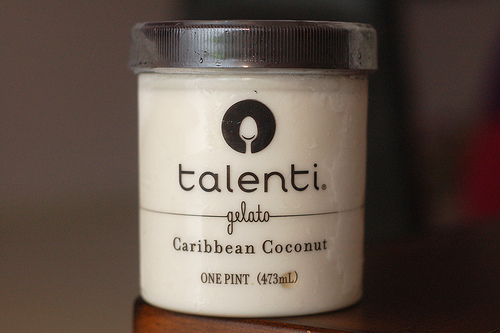
Talenti Caribbean Coconut Gelato – product review
Introduction
Talenti is one of my favorite ice cream/gelato companies, with a wide range of tasty products sporting a sleek and modern design, which looks even better after their recent rebranding effort (done in March 2013).
I reviewed their coffee-flavored ice cream in a previous post here, and this time I thought I would talk about another one of their flavors – Caribbean Coconut. I love it’s name which combines catchy alliteration with an island paradise atmosphere.
Flavor
This gelato takes a simple, light ice cream base with a touch of vanilla and mixes in a generous portion of shredded coconut. I’m not exaggerating, there is really a lot of coconut here. When you run your spoon through it you can see the little piece of coconuts, or feel their rough texture if you let the ice cream melt slowly on your tongue.
I always say a good ice cream needs a balance of two or more contrasting things. Talent’s Caribbean Coconut just barely manages that – the creamy light base against the shredded coconut pieces, and the strong milk taste against the subdued coconut. The milk flavor, reminiscent of drinking chilled milk, blends together with the coconut flavor so well that you can’t tell where one begins and the other ends. With such simple flavors I’m not sure how they did it, but the end product is a very satisfying experience for the senses.
The only weak point of this gelato, if you could even call it that, is that its lightness doesn’t make it very filling. After eating half of the pint, you’re hard pressed to not just finish it off.
Nutrition/Ingredients
There is 190 calories in a single 100 gram serving, about average in its class if not slightly on the low side. Sugar is a bit excessive for my liking at 24 grams.
There’s nothing nutritionally special about the product according to the label’s information: 3 grams protein, 0 grams fiber, and minimal vitamins and minerals. But there is surely other important nutrients present that are not captured there.
The strongest selling point of this ice cream (besides the great flavor) is it’s short, simple list of ingredients. There is only seven, with no artificial anything, and (impressively) no “natural flavor”. Add the potential nutritional benefits of coconut – listed 4th so there may be as much as 25% coconut – and you get a big thumbs up from me!
The complete list is milk, sugar, cream, coconut, dextrose, carob gum, and vanilla.
Milk listed as the first ingredient explains the strong milk flavor. There is really a lot of milk in this dessert.
Dextrose is another name for glucose, one of the basic sugars. It’s is less sweet than fructose, and the “sugar” listed second place on the label is simple table sugar, which contains roughly half glucose and half fructose. I’m not sure why Talenti would need to supplement with dextrose, possibly as a money-saving effort. I wonder what the effect would be of simply removing the dextrose and adjusting the table sugar to give the desired sweetness.
Someday I hope to many a similar ice cream myself, where I increase the amount of coconut while dialing down the sugar. If I’m lucky I can raise the nutritional value without sacrificing taste too much.
Price/Availability
This product is available at Publix, Whole Foods, Target, and other supermarkets. The price is around $5.00 – $6.00, with online pricing around $8.00.
Ratings: Flavor: 8.5 Nutrition/Ingredients: 8.5 Price: 7.0 Overall: 8.0
Summary
This ice cream has a rare combination of natural ingredients and fresh, simple taste that makes it one of my favorites. It’s a must try for anyone who is a fan of coconuts, or looking to upgrade their vanilla to a product with simple, healthy ingredients.
References

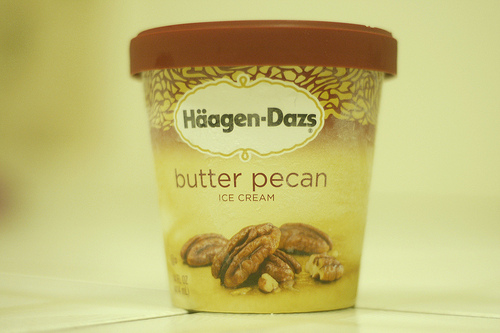
Haagen Dazs Butter Pecan ice cream
Introduction
I typically don’t eat Haagen-Dazs ice cream, but since it was buy one get one free I decided to try their Butter Pecan flavor, which was one of the lower sugar choices in their lineup. It’s not that there is anything wrong with this brand per se, but Haagen Dazs feel very generic to me in that it has been around as far as I can remember and isn’t marketed as being particularly healthy or different. I guess being around since 1961 you could call it a ‘classic’ ice cream company. Having said that, I’ll try to put aside my biases aside when reviewing this product.
Flavor
This ice cream tastes like your typical butter pecan, except that it it has a very strong cream flavor. I’ve made ice cream myself and used a large proportion of heavy cream (which contains 36%-40% milk fat) and it tasted similar.
My problem with this product is monotony – in both appearance and flavor. The brown pecans set against the plain white aren’t particularly visually appealing, but more importantly the flavor of the thick, creamy base isn’t different enough from the sweet pecans (which aren’t exactly crunchy), and as a result I get tired of eating this ice cream quickly. To put it another way, this ice cream lacks balance between two opposing flavors and textures. If I was tasked to improve the flavor, first I’d make the base lighter, possibly adding some other mild flavor and natural food coloring. Then I’d add more pecans, using larger ones if they exist, and possibly removing or reducing the butter from the pecans. Yes, I realize this would make the flavor less “butter pecan”, but the butter flavor and the cream flavors are too close for my taste.
Nutrition/Ingredients
In a 100 gram serving there is 300 calories, slightly higher than the average of other Haagen Dazs ice cream products I’ve looked at, but very high if you compare to some other companies such as Talenti and So Delicious desserts. Sugar content is a bit below average with 17 grams per serving
There is a nice portion of protein with 5 grams per serving, but the fat per serving (22 grams) is off the chart – its literally the highest I have seen in recent memory and helps to explain why the flavor is so heavy. I checked a few other brands and their versions of butter pecan all had less fat, with Bryer’s butter pecan containing less than half fat per serving (roughly 10 grams). Personally, I value overall number of calories more than fat content, but as I mentioned those are quite high as well.
The full list of ingredients are: cream, skim milk, sugar, skim milk (lactose reduced), pecans (pecans, coconut oil, salt, butter [salt, cream]), corn syrup, egg yolks, salt, vanilla extract
In spite of my problems with high calories, fat, and taste, the ingredients in this ice cream are actually quite healthy, as least as far as ice creams go. There are no preservatives, no artificial colorings, no artificial flavorings, or even natural flavorings. In fact, there aren’t any thickening agents such as guar gum either. Though I don’t consider this latter category to be necessarily unhealthy, I almost always prefer less ingredients, especially ones that are not everyday items I would use in the kitchen.
Some may spot “corn syrup” and associate that with “high fructose corn syrup”. While its true they are both made from corn, plain “corn syrup” contains more glucose as opposed to fructose, which is sweeter. While there is some research showing high amounts of fructose are harmful to the body if consumed frequently, some people maintain that these sugars all have similar effects on the body. After all, fruits naturally contain fructose (as well as gluctose and fructose), and table sugar is roughly half glucose and fructose.
Price/Availability
This sells all over but typically can be bought at Publix for around $4.69.
Ratings: Flavor: 5.0 Nutrition/Ingredients:7.5 Price:8.0 Overall: 6.8
Summary
A high-fat, high-calorie ice cream with reasonable ingredients that is worth a try for fans of butter pecan, but I found its heavy cream flavor a little too much.
References
http://www.haagendazs.com/Products/Product/2449
http://candy.about.com/od/candybasics/a/creamguide.htm
http://nutrition.about.com/od/grainsandcereals/f/fructosesyrup.htm

So Delicious Coconut Milk German Chocolate Frozen Dessert – product review

Introduction
I’m a proponent of all type of ice creams, including soy, coconut, and even goat milk-based. I’ve previously reviewed one of Luna Larry’s Coconut Bliss products (here), and this time I decided on reviewing another brand’s coconut frozen desserts that is soy free and dairy free.
I’ve had real German chocolate cake, as well as Cold Stone Creamery’s ice cream of the same flavor, and enjoyed both immensely. Unintentional or not, I’ll be comparing this to those products.
Flavor
To be honest, the first time I tasted this frozen dessert, I was a bit disappointed with the flavor. But when I tried it again the next day, it tasted much, much better. It took a mighty effort of willpower to stop myself from eating 2/3rds of the carton in a matter of seconds. From this I deduced two possible reasons for the difference in enjoyment. The first is that I was tired, not to mention on a full stomach, so my body was rejecting the ice cream. The other reason is that maybe it took my taste buds two tries before it “got” the flavor and learned to appreciate it fully. In any case, I’ll try to sample something on two separate days before I complete my review, whenever possible.
The appearance of this ice cream isn’t too appetizing, at least when compared to Cold Stone’s version (see references section below for a nice picture of the latter). The nuts are small and their color blends in with the chocolate so they don’t stand out. The coconut shavings are also few and far between, and blend into the chocolate and caramel base.
However, as you gradually start to shovel spoon after spoon into your mouth (of course after letting it partially melt) your doubts start to disappear. Rich chocolate swirled with sweet caramel, coconut shavings that tickle the tongue, and crunchy pecan pieces that entertain the teeth – its all there. There is no brownie as with the Cold Stone version, but the flavor is comparable and there is approximately 200 less calories and half the sugar.
If you take a deep whiff you’ll notice the coconut smell stands out, with a slight overtone of the caramel. There is little to no chocolate scent as cocoa is used in relatively small proportion compared to the coconut and caramel ingredients.
Nutrition/Ingredients
This product has 180 calories in a single 85 gram serving, slightly lower than the average of equivalent milk-based creams. Its also slightly higher than some of the other flavors of So Delicious coconut milk.
Sugar content is 14 grams per serving, which is typical for other coconut based frozen desserts, but quite low compared to many milk-based creams. I’m always amazed with the apparent sweetness of coconut-based products given their low sugar content. Its probably because agave syrup is commonly used, which is roughly 1.5 times sweeter than table sugar due to a high concentration of fructose. I’ve mentioned in a previous post that agave is potentially healthier than table sugar, but keep in mind that is still unproven and it may turn out that there is no difference from a nutritional point of view.
There is only one gram of protein in contrast to the relatively high fiber (6 grams of fiber which is 24% DV). I believe most of this comes from the chicory root extract which is high in fiber. Vitamins and Minerals, as listed on the package, are negligible except 6% of Iron.
Here is the full list of ingredients:
ORGANIC COCONUT MILK (WATER, ORGANIC COCONUT CREAM), ORGANIC AGAVE SYRUP, ORGANIC DRIED COCONUT, CHICORY ROOT EXTRACT, CARAMEL SAUCE (ORGANIC TAPIOCA SYRUP, WATER, MOLASSES, PEA PROTEIN, NATURAL FLAVORS, ORGANIC COCOA BUTTER, SODIUM CITRATE, SALT, CARRAGEENAN), PECANS, COCOA (PROCESSED WITH ALKALI), CAROB BEAN GUM, GUAR GUM, NATURAL FLAVOR.
Sodium citrate is used for flavor and also to regular acidity, and carob bean gum and guar gum are both used as thickeners to control texture. I’ve been seeing this in many of the products I’ve reviewed lately, but “natural flavor” is always a bad thing to me due to lack of transparency.
Carageenan, a substance extracted from seaweed, is used to thicken and stabilize the dessert. While it is generally accepted by the FDA as a food additive, some experts advise against using it in infant formulas, and some scientific research had indicated there is a possibility it can promote cancer. However these results were done with tissue cultures as opposed to directly with human subjects, and they are disputed by the scientific community.
I feel that the most nutritious ingredient in this dessert, by far, is the coconut itself – in the form of coconut milk and dried coconut. Though I am skeptical on those who claim coconuts are a “superfood” or one can live purely off them, there is a large number of vitamins and minerals in them: potassium, phosphorous, iron, zinc, folate, and manganese, among many others. There is also a large number of health benefits claimed, including raising good cholesterol, helping the immune system, and promoting heart health. (Check out the links I have provided in the references section for a starting point on researching coconut’s potential benefits.) I don’t think there is enough evidence to be 100% certain of many of these supposed benefits, but from the point of view that a wide variety of foods are good for health I feel it is wise to include some coconut in your (ice cream) diet.
On a final note, I’d like to mention a word of caution about how much nutrition coconut actually contributes to this product. While “coconut milk” is listed first on the label, and hence highest in proportion that other ingredients, coconut milk itself consists of water and coconut cream, with water in higher proportion. From this all that we can determine is that the coconut milk is at most 50% coconut cream, possibly much less. That would actually put the amount of coconut cream used less than other ingredients, such as agave which is listed second.
Price/Availability
I picked this up at Whole Foods Market for around $4.99 on sale, whereas it usually sells for $5.99.
Ratings: Flavor: 8.0 Nutrition/Ingredients:7.5 Price:7.0 Overall: 7.5
Summary
This frozen dessert combines the potential health benefits of coconut with a reasonable amount of sugar and calories, not to mention an unforgettable flavor that makes it one of my favorite coconut-based ice creams.
References
http://sodeliciousdairyfree.com/products/coconut-milk-frozen-desserts/german-chocolate
http://www.coldstonecreamery.com/icecream/signaturecreations/germanchokolatekake/index.html
http://www.myfitnesspal.com/food/calories/cold-stone-creamery-german-chocolate-like-it-852207
http://inrfood.com/ingredients/419
http://en.wikipedia.org/wiki/Carrageenan
http://www.nutrition-and-you.com/coconut.html
http://healthism.blogspot.com/2011/07/vitamins-and-minerals-in-coconut.html
http://authoritynutrition.com/top-10-evidence-based-health-benefits-of-coconut-oil/

Talenti Chocolate Coffee Chocolate Chip – company response on caffeine content and natural flavors query
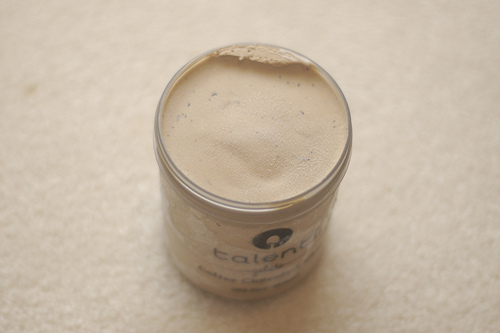
I had previously reviewed Talenti’s Chocolate Coffee Chocolate Chip ice cream, which maintains first place for my most loved ice cream. In that post I discussed sending an email to the company requesting more information about this product, and since I received a response from them I decided to write it up as a new post. The original blog post is here for those interested.
I had requested two things from them: caffeine amount and detailed explanation of “natural flavors”. The former was because I had felt quite a ‘kick’ from eating this and wanted to determine whether that was from sugar, caffeine, or something else. I asked the latter from my uneasiness as to what I am actually eating. It’s apparently ‘natural’ but what is it really? Consumers who want to research more about the possible side effects and nutrition of this catch-all ingredient are at a loss.
First I’ll give an excerpt of the polite email I received from Talenti, followed by my comments on it.
===
Thank you for the inquiry. We do understand your concerns regarding “natural flavors’ in our ingredients.
Ingredient Math – estimating worst (or best) case for ingredient proportions
Have you ever wondered how much of a certain ingredient is really present in a sweet, or any food product?
You probably know that ingredients are listed on food labels in order or prevalence, with the most predominant ingredient first. You may have even known this was determined by weight. But in this article I will discuss a method to get an estimate for the maximum of each ingredient’s percentage of total weight – just by using the ordered ingredient list.
To derive this formula, lets start with a very simple example, a product with just “coffee and sugar”. Since coffee is listed first we know it has higher or equal amount of total weight when compared to sugar.
Is there anything we can do to determine about how much the first ingredient, coffee, is really in the product? The answer is no because coffee could be almost 100% to almost 0% of the total weight, with sugar filling in the remaining space. (Actually, there is a trick to determine the amount here since the second ingredient is sugar, which I’ll discuss later in this article).
But what about the sugar?
Well, if you think about it, there can’t be more than 50% sugar, by weight, since any more of that would mean there was more sugar than coffee, which we know is not the case.
So we’ve learned something important – that there is no more than 50% sugar in the product. This would apply to another second ingredient when there are two total ingredients.
What if there were three or more total ingredients? We would get the same result, because the other ingredients could be in trace amounts (practically 0%), so the “50% maximum for the second ingredient” rule would still apply.
What about the maximum amount of the third ingredient? Using the same logic you will see it cannot be above 33.3%, since any more of that would mean it is in greater proportion than the first and second ingredients. And for the forth ingredient you get a maximum, by weight, of 25%.
Turning this into a simple formula we get the following:
Maximum percentage of the Nth ingredient = (100 / N)
So for the 5th ingredient, you would get (100 / 5) = 20% maximum weight of that ingredient.
If you use formula along with the serving size you can determine the maximum weight of any of the ingredients per serving. Pretty handy if you want to minimize your intake of certain things.
If you want to take this to the next step, you can infer more information when one more more ingredients are a type of sugar. For example, if a product contains “coffee, sugar” and has 3 grams of sugar per 15 gram serving, then you know right away there is 20% sugar and 80% coffee in this product. Keep in mind that the grams of sugar listed includes any type of sugar, so if you have multiple ingredients which contain some type of sugar (even fruits) then the calculation gets a little trickier.
Besides knowing there is a certain percentage of sugar, you can use that to deduce information about other ingredients.
For example, if the imaginary product I just described had a third ingredient, say “coffee, sugar, vanilla”, then you would know that there is 20% or less vanilla because sugar is 20% or less. This assumes that there is no sugar in the vanilla, otherwise it would be harder to make any definitive conclusions.
Similarly, if you know how much protein is in each ingredient, you can figure out even more using the supplied protein in grams.
You can also leverage information about other ingredients to deduce additional information about the other ingredients. For example if a product had “milk, sugar, guar gum, vanilla”, you would know that the proportion of vanilla is much less than 25% since guar gum is typically used in relatively small doses. (I’ve tried overusing guar gum in homemade ice cream – its not pretty!)
I love thinking about food and ingredients from a methodical, logical point of view since it allows me to apply science to my everyday life.
References

Meet the Sweets Reporter
Hello, I’m the Sweets Reporter, thanks for reading!
With a nearly uncountable number of people on this planet addicted to sweet treats, why did I decide to dedicate some of my treasured free time to reporting on a variety of delicious, delightful sweet things?
Well, for starters I’m the type of person who almost always has something sweet at night before going to bed, and have been doing so as long as I can remember. In the last few years I also have been paying more attention to what is in the sweets I eat – for health reasons as well as just natural curiosity about what makes great flavor. And finally, I feel as if the “scientist” part of me – the tendency to analyze and report detailed observations – makes me a perfect candidate for a critic of sweets. Its even taken me to the point where I have tried making my own confections (ice cream, cookies, etc.) using experimental recipes.
I hope you’ll join me on this journey, where each stop is a flavorful concoction designed to delight the senses.
One more thing before we move onto the first sweets review. Having read my share of food (and other) reviews, I am quick to pick up on those who put a positive spin for commercial reasons. Though I don’t expect to focus on items which I don’t enjoy eating, for those I do decide to review I’ll be giving my thorough, honest take. Even my favorite sweets have drawbacks, and I want to give my readers an unbiased (well, as much as a human can be unbiased) commentary on things. In any case, I’ll do my best to convey my feelings to you as if you had just popped it into your mouth, senses savoring all the glory of its sweetness.


 Sweets Reporter