
Ingredient Math: Calculating minimum ingredient proportions

In a previous article here, I showed how to calculate the maximum proportion of a ingredient listed on a food label. I derived the following simple formula:
Maximum percentage of the Nth ingredient = (100 / N)
This time I’ll use similar logic to derive a formula for the minimum amount of an ingredient, based on only its order in the listing and the total number of ingredients.
Let’s start with the simple case of a product with two ingredients: “sugar, cocoa”.
With a little thought, we can see that sugar cannot be any less than 50%. If it was, then cocoa would have to be greater than 50% (since it equals 100% – sugar) and that is impossible based on the ordering rule that the most prominent ingredients, by weight, are listed first.
What about cocoa? Clearly it has no minimum since it could be 0.00001%, leaving the remaining 99.9999% to sugar.
Next let’s try a product with three ingredients: “sugar, cocoa, shredded coconut”.
Using similar logic, we will see the minimum amount of sugar is 33%, since any less than that would mean the other ingredients would have to have a higher proportion than sugar. If we assumed sugar was 20%, then the other two ingredients must add up to 80%, and therefore one of them must be present in at least 40% proportion – but that is greater than sugar which is listed first!
And the second ingredient? Just like the second ingredient in the two-ingredient example, this can be arbitrarily small. For example: 99.9% sugar, 0.09% cocoa, and 0.01% shredded coconut.
To generalize these results:
Minimum percentage of the 1st ingredient = (100 / T), where T is the number of total ingredients
Minimum percentage of the other ingredients = infinitesimally close to zero
As with the calculations of maximum proportion in my previous article, if we have additional information about the other ingredients we can use that to determine the minimum level of the other ingredients. For the same example, if we sifted and then weighed the shredded coconut (third ingredient), we could determine its overall proportion by weight. Lets say this is 10%. Then we could reason that cocoa, the second ingredient, takes up a minimum of 10% total weight since it must be equal or greater to the amount of shredded coconut. From this we could also conclude sugar (the first ingredient) is at most 80% of the total weight.
You can use nutritional values such as protein and fiber to infer how much of certain ingredients are present, especially if those have a large proportion of a certain element.
You may feel that this sort of calculation may seem unlikely to have any practical use, but if you find yourself saying “I eat so-and-so product because it contains a large amount of X, which is healthy”, then you can use it to see the minimum level of that ingredient you are consuming.
Another use is if you are trying to make a homemade version of something and you want to get a feel for the minimum and maximum amount of it in the product.

Product Review: Ben & Jerry’s Frozen Yogurt Chocolate Fudge Brownie

This ice cream is from the “FroYo” series which takes popular Ben & Jerry’s flavors and turns them into frozen yogurt with reduced calories and fat. I had reviewed the ice cream (non lowfat) version of Chocolate Fudge Brownie here, and this time I thought I would review the lowfat one. It’s great when you want a deep, rich flavor without quite as many calories.
Flavor
This dessert tastes very similar to the ice cream version. Spongy brownie pieces float in a sea of rich, gooey chocolate, saturated with sugary goodness throughout.
I’m sure if did a direct taste comparison where I alternated between spoonfuls of these two products I would be able to taste the difference more clearly, but eating it normally the FroYo doesn’t taste anything like “low-calorie” or “low-fat” – which is a good thing. The main difference is that the texture is more icey and less creamy. It’s midway in between eating normal ice cream and Italian ice (the latter of which has no milk and only water as its base).
The first time I tried this I didn’t taste any of the yogurt flavor. I tried it again, paying close attention, and was able to detect yogurt very subtly, more as an aftertaste than anything else. More on this below.
Nutrition/Ingredients
For a single 104 gram serving there is 180 calories, slightly below average for an ice cream of this type. Consistent with the “lowfat” branding, there is only 2.5 grams of fat. Compare these figures to the normal Chocolate Fudge Brownie – 270 calories and 12 grams of fat – and you’ll see a huge difference.
For those of you who are more concerned about sugar intake than calories (which I sometimes am), this product isn’t too great. There is a whopping 25 grams of sugar, only 2 grams less than the standard less-healthy version. I’d wish they would have reduced it a bit more, but I guess the characteristic flavor would be ruined if they took out any more sugar.
Protein amount is typical at 5 grams, and fiber is 2 grams a serving.
As I mentioned above, this product has only a tiny hint of yogurt taste. I checked on what “frozen yogurt” really means, and it looks like besides containing yogurt, it is also typically more tart, and lower in fat due to milk used in place of cream. Comparing ingredients against the normal ice cream version, we can see that both contain skim milk and cream. However the FroYo version contains more skim milk than cream (order on label 2nd and 9th, compared to 3rd and 1st on the ice cream version). So this frozen yogurt does contain less fat, although it is not particularly tart.
Technically this product can be placed in the “frozen yogurt” category because of the presence of yogurt powder (11th place) and yogurt cultures (20th and last place). However, because of the small amount of these ingredients, which is reflected in the taste, I wouldn’t really consider this a true “frozen yogurt”. It looks like Ben & Jerry’s is just using the “yogurt” nomenclature to associate nutrition and health, and as a result sell better. I can’t say whether the yogurt cultures have any nutritional benefit or not, but they in are such small proportion I doubt that is much an effect, if at all. I’d prefer B&J’s either drop the yogurt branding and remove the little yogurt that is present, or increase it so this dessert can honestly be called a “frozen yogurt”.
Another trick they use to make this product lighter is using water as a filler – it’s listed as the #1 ingredient and is the main reason for the texture change I discussed previously. I think this is generally a great idea for health-conscious frozen desserts, and when done in moderation doesn’t destroy the flavor.
I’ve listed both versions’ ingredient list below. If you compare you’ll see that except for the yogurt, milk/cream, and water differences, they are very similar.
FroYo version (this product):
Water, Skim Milk, Liquid Sugar (Sugar, Water), Corn Syrup, Sugar, Cocoa (Processed With Alkali), Wheat Flour, Corn Syrup Solids, Cream, Cocoa, Nonfat Yogurt Powder, Egg Yolks, Butter (Cream, Salt), Eggs, Egg Whites, Locust Bean Gum, Salt, Vanilla Extract, Sodium Bicarbonate, Yogurt Cultures
ice cream version:
CREAM, LIQUID SUGAR (SUGAR, WATER), SKIM MILK, WATER, SUGAR, COCOA (PROCESSED WITH ALKALI), WHEAT FLOUR, COCOA POWDER, EGG YOLKS, BUTTER (CREAM, SALT), INVERT SUGAR SYRUP, WHOLE EGGS, EGG WHITES, GUAR GUM, SALT, CARRAGEENAN, VANILLA EXTRACT, MALTED BARLEY FLOUR, SODIUM BICARBONATE.
One final difference is that the FroYo version does not contain carrageenan, a substance used as a thickener/stabilizer. It turns out there is some research that indicates carrageenan may be involved in tumor promotion, though I don’t think there is any definitive proof for this yet, and currently it is considered as a safe food additive by the FDA. Nevertheless I’d rather do without it if I have a choice.
Price/Availability
This product is available all over the place. I purchased it for $4.69 at Publix supermarket.
Ratings: Flavor: 8.0 Nutrition/Ingredients:7.0 Price:8.0 Overall: 7.6
Summary
This doesn’t stand out as a particularly healthy choice, but when compared against the less healthy non-yogurt version it’s much lower in calories and fat, and still boasts a rich, sweet taste. Once you switch to FroYo I doubt you’ll find the need to return to more fattening ice cream.
References
http://www.benjerry.com/flavors/our-flavors#product_id=650
http://www.benjerry.com/flavors/our-flavors#product_id=611

Product Review: Justin’s Maple Almond Butter Spread
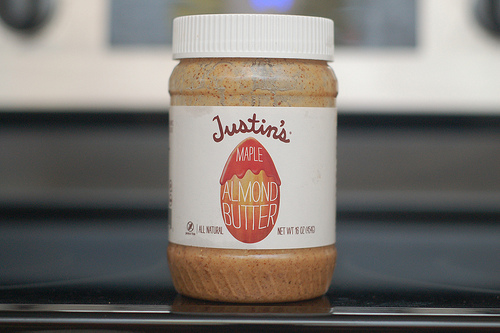
Introduction
I’m a heavy consumer of Justin’s Chocolate Hazelnut Butter (which I reviewed here), but regardless of how healthy and tasty it is I need a break from it from time to time. I decided to try another product in this series, an Almond Butter sweetened with natural maple sugar.
Flavor
I hope you’ll pardon the cheesy turn of phrase, but I’m nuts about nuts. Essentially seeds from a plant which grow in a hard shell, these amazing creations of nature are one of the few things that have a rich, savory flavor in their unprocessed natural form.
Start with a paste made from dry roasted almonds and add maple sugar for an extra touch of sweetness, palm fruit oil for increased spreadability, and round off the taste with a pinch of salt, and you get a spread made in heaven.
I’m not going to attempt to explain the intricate flavors contained with almonds, but this product will surely appeal to anyone who likes peanut butter or eating raw almonds.
There is a surprising sweetness for the actual amount of sugar present. This is because maple syrup primarily consists of sucrose, whose sweetness lies between fructose and gluctose, and as a result is approximately twice as sweet as table sugar.
My only minor complaint is the ratio of oil is a bit high. When I spread a blob of this on my bread with a knife, sometimes it overflows onto my plate and this messiness isn’t desirable.
Nutrition/Ingredients
A single serving (two tablespoons) of this thick spread contains 200 calories and 17 grams of fat. As I mentioned in my hazelnut butter review, the problem with spreads is that its hard to meter how much you eat. If you’re not careful you can wolf down 1000 calories or more in a span of minutes. For those concerned about their weight it’s best to eat this in very small doses, but everyone else shouldn’t feel any guilt when eating this. With minimally processed natural ingredients, if you going to go overboard with calories and fat this is probably the safest way to do it.
There is a minimal 3 grams of sugars per serving, less than half found in Justin’s chocolate spreads. Interestingly, the “classic” version of this paste, containing no added sugar, contains nearly the same amount of sugars at 2 grams. If you find the maple overtones bother you, feel free to try the classic version. I’ve had it and its even stronger almond taste is superb.
There is 6 grams per serving which is a good amount, especially considering that you are likely to consume multiple servings in a single sitting. This is natural protein from the nuts themselves, not something added artificially.
Both almonds and maple sugar are packet with nutrients. Almonds contain Vitamin E, manganese, copper, Vitamin B2, among others, and are considered to be very heart-healthy. Maple sugar contains a large amount of manganese, zinc, and also contains substances called polyphenols that may help control blood sugar levels. It’s estimated glycemic load is less than that of table sugar and only slightly more than honey, though diabetics still need to be careful when eating it.
Palm fruit oil, a less popular form of oil, has its own set of potential health benefits including cancer prevention, immune system strengthening, and reducing heart disease.
Full ingredients list: Dry Roasted Almonds, Maple Sugar, Organic Palm Fruit Oil, Sea Salt.
Price/Availability
Like most of Justin’s products, this sells for around $10.00 per a 454 gram jar. When compared to everyday peanut butter this is quite expensive, but its competitive to other almond butters. After all, this product is mostly made of almonds, which have a unit price roughly double that of peanuts. Justin’s peanut butter goes for a roughly proportional price ($6.00).
I usually buy this at Whole Foods but its also started appearing at Target and other stores recently. Its also available from the producer directly via their website, and packs of 6 are sold for a slight discount. Justin’s nut butters are also sold in single serving packs.
Ratings: Flavor: 8.5 Nutrition/Ingredients:9 Price:7.0 Overall: 8.2
Summary
With a rich taste and packed with nutrients, I’m apt to call this the perfect snack food – if it weren’t for the high calorie and fat content. I consider this, along with the other products in Justin’s lineup, to be the best available spreads judging from taste and nutrition content.
References
http://www.justins.com/products.php
http://www.thenutbox.com/Nuts-s/1.htm
http://greenlitebites.com/2010/11/11/sweetener-comparisons-honey-agave-molasses-sugar-maple-syrup/
http://en.wikipedia.org/wiki/Nut_(fruit)
http://www.whfoods.com/genpage.php?tname=foodspice&dbid=20
http://www.sugar-and-sweetener-guide.com/glycemic-index-for-sweeteners.html
http://diabeteshealth.com/read/2011/05/24/7158/maple-syrup-a-sweet-surprise/
http://www.doctoroz.com/videos/why-you-should-give-red-palm-oil-try


Product Review: Clif Vanilla Almond Builder’s 20g Protein Bar
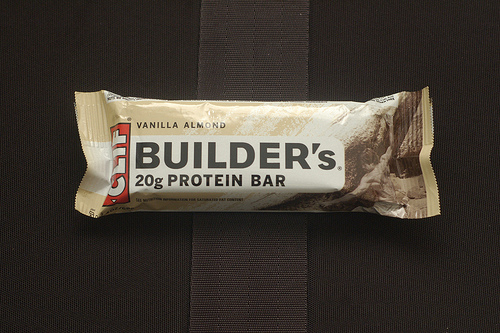
There was a time in the last year or two when I was into weightlifting. As many weightlifters do, I tried to get as much protein as possible to help maximize my muscle mass by using protein bars, shakes, and the like. I have since stopped lifting, and also discovered there isn’t much conclusive research showing that excess protein really helps develop more muscle. So for the most part I’ve given up on all the protein supplement products.
Clif’s Vanilla Almond Builder’s protein bar is the one thing in this category I still eat from time to time, not for the protein but because it’s just so darn tasty. Not surprisingly, it also happens to be quite sweet.
Flavor
My first feeling when removing this protein bar from the wrapper is that it’s really *big*. It’s solid rectangular shape hints at the bulging muscles you might get with frequent consumption of it (of course, assuming you do the necessary weight training). On its way to your mouth, this solid mass of protein and almonds gives off a very strong scent of vanilla, whetting your appetite.
As you sink your teeth in, you put in a little extra force to bite off a chunk, after which your jaw gets a real workout on chewy, sweet stuff.
This bar is composed of three parts. The outside is coated in a sugary vanilla frosting that is the star of the show, thick on the bottom but thinly painted on the top. Within there are two layers, the larger bottom one comprised of tiny almond pieces that are held together by something sticky with the appearance of brown sugar. This has only a mild sweetness if eaten on its own, pale in comparison to the candy-like frosting. The top layer, partially visible by the thin coating on top, is made of very dense, chewy soy protein isolate. It doesn’t have too strong of a taste on it own. In fact I’m impressed how they’ve managed to cover up the texture and taste of powdered protein, which is not exactly what I would call appetizing.
This bar does an excellent job at filling you up so you can continue on with exercise. In my case it filled me up for an hour or two, if not longer. A minor side effect is that it really makes you thirsty. I typically drink a glass of cold water while eating it, and another after I’ve gobbled it up. The flavor tends to stay around in your mouth for a while afterwards and the water helps lessen this effect.
If I had to describe this product in a single word I would say “addictive”. From the fresh vanilla scent to the delicious chewy texture, Clif and his company have truly crafted a masterpiece of sweet nutrition.
If little frosting pieces didn’t break off and make little white smears on my clothes it would be perfect, but for those who aren’t messy eaters like me this won’t apply to you.
Nutrition/Ingredients
In one bar (68 grams / 2.4 ounces) there are 270 calories. This figure should be judged differently than other sweet products, since the whole point of this bar is to give your body some nutrition so it can keep working, or start rebuilding muscle before you have a chance for a proper meal. Remember this type of product should never replace a real, complete meal with fresh vegetables, starches, and meat (if you aren’t a vegetarian, that is).
There is of course the massive 20 grams of protein, plus 240 mg of salt (10% DV), 170 mg of potassium (5% DV) and 3 grams of fiber (12% DV).
This is a big portion of sugar, 22 grams, which I don’t consider a bad thing if you are consuming this product during or after exercise. After all, your body does need some sugar to function properly. However, for this like myself who simply indulge in this as a tasty snack there may be a little guilt, especially given the sugar per weight (roughly 32 grams sugar / 100 grams total weight) is higher than many ice creams!
Actually I take that back – this is one of the few products where you shouldn’t feel very guilty about the high sugar content. The reason is that there is several different sweeteners used, at least one or two of which has the potential to be healthier than your average added sugar: beet juice, brown rice syrup, and dried cane syrup. Sure, it may turn out that after all “sugar is sugar” and your body handles these roughly the same, but until that is 100% proven I think you’re better off with a variety of sweeteners as opposed to a load of everyday table sugar.
Except for the “Natural Flavors” which I have a deep hatred of, the rest of the ingredients are very healthy. There is a mix of oils from natural sources (palm kernel oil, sunflower oil), natural seeds (flaxseed, quinoa), oats, almond butter, and almonds.
The only other thing which is potentially unhealthy is the soy protein isolate itself, more because it is in super-concentrated form (and hence unnatural) than because of claims of soy’s effects on testosterone, which have for the most part been proven invalid. Complaining about this ingredient when it is the primary selling point of the product doesn’t make much sense, because those purchasing it know full well what they are buying.
The full ingredient list is: Soy Protein Isolate, Beet Juice Concentrate, Organic Brown Rice Syrup, Organic Dried Cane Syrup, Palm Kernel Oil, Organic Rolled Oats, Almond Butter, Organic Soy Flour, Almonds, Vegetable Glycerin, Organic Quinoa, Organic Vanilla, Organic Sunflower Oil, Inulin (Chicory Extract), Rice Starch, Organic Flaxseed, Organic Oat Fiber, Natural Flavors, Soy Lecithin, Salt.
Vitamins & Minerals: Dicalcium Phosphate, Magnesium Oxide, Ascorbic Acid (Vit. C), Tocopheryl Acetate (Vit. E), Ferric Orthophosphate (Iron), Beta Carotene (Vit. A), Zinc Citrate, Phytonadione (Vit.K1), Biotin, Niacinamide (Vit. B3), Calcium Pantothenate (Vit. B5), Potassium Iodide, Manganese Gluconate, Copper Gluconate, Sodium Selenite, Thiamin (Vit. B1), Chromium Chloride, Cyanocobalamin (Vit. B12), Sodium Molybdate, Folic Acid (Vit. B9), Riboflavin (Vit. B2), Pyridoxine Hydrochloride (Vit. B6).
The long list of vitamins and minerals could be a blessing or a curse, depending on your stance regarding these food additives. I think they may help and are less likely to cause harm, and am therefore cautiously positive on them. Again, if you are the type of person who balks at vitamins added to a food product you wouldn’t likely be looking for a protein bar in the first place.
33% of the ingredients are Organic, which is nice bonus because the product is not openly marketed as a organic product.
Price/Availability
These are sold are various supermarkets, including Publix and Whole Foods Supermarket, from $2 – $3. If you buy wholesale online (in packs of 12), you can get the price down to $1.50 a bar.
Ratings: Flavor: 9.0 Nutrition/Ingredients:8.0 Price:7.5 Overall:8.2
Summary
If you’ve looking for a great way to grab a load of protein quick during or after exercise, this tasty mix of mostly natural ingredients is highly recommended. Those with a sweet tooth who are less active should find it equally appealing as a delicious snack.
References

Talenti Caribbean Coconut Gelato – product review
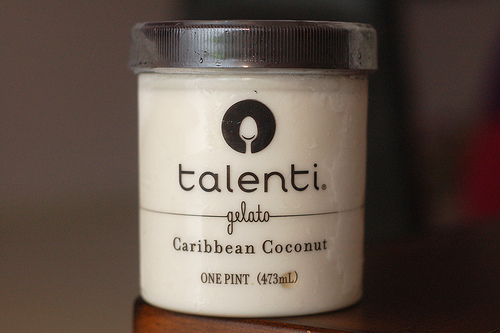
Introduction
Talenti is one of my favorite ice cream/gelato companies, with a wide range of tasty products sporting a sleek and modern design, which looks even better after their recent rebranding effort (done in March 2013).
I reviewed their coffee-flavored ice cream in a previous post here, and this time I thought I would talk about another one of their flavors – Caribbean Coconut. I love it’s name which combines catchy alliteration with an island paradise atmosphere.
Flavor
This gelato takes a simple, light ice cream base with a touch of vanilla and mixes in a generous portion of shredded coconut. I’m not exaggerating, there is really a lot of coconut here. When you run your spoon through it you can see the little piece of coconuts, or feel their rough texture if you let the ice cream melt slowly on your tongue.
I always say a good ice cream needs a balance of two or more contrasting things. Talent’s Caribbean Coconut just barely manages that – the creamy light base against the shredded coconut pieces, and the strong milk taste against the subdued coconut. The milk flavor, reminiscent of drinking chilled milk, blends together with the coconut flavor so well that you can’t tell where one begins and the other ends. With such simple flavors I’m not sure how they did it, but the end product is a very satisfying experience for the senses.
The only weak point of this gelato, if you could even call it that, is that its lightness doesn’t make it very filling. After eating half of the pint, you’re hard pressed to not just finish it off.
Nutrition/Ingredients
There is 190 calories in a single 100 gram serving, about average in its class if not slightly on the low side. Sugar is a bit excessive for my liking at 24 grams.
There’s nothing nutritionally special about the product according to the label’s information: 3 grams protein, 0 grams fiber, and minimal vitamins and minerals. But there is surely other important nutrients present that are not captured there.
The strongest selling point of this ice cream (besides the great flavor) is it’s short, simple list of ingredients. There is only seven, with no artificial anything, and (impressively) no “natural flavor”. Add the potential nutritional benefits of coconut – listed 4th so there may be as much as 25% coconut – and you get a big thumbs up from me!
The complete list is milk, sugar, cream, coconut, dextrose, carob gum, and vanilla.
Milk listed as the first ingredient explains the strong milk flavor. There is really a lot of milk in this dessert.
Dextrose is another name for glucose, one of the basic sugars. It’s is less sweet than fructose, and the “sugar” listed second place on the label is simple table sugar, which contains roughly half glucose and half fructose. I’m not sure why Talenti would need to supplement with dextrose, possibly as a money-saving effort. I wonder what the effect would be of simply removing the dextrose and adjusting the table sugar to give the desired sweetness.
Someday I hope to many a similar ice cream myself, where I increase the amount of coconut while dialing down the sugar. If I’m lucky I can raise the nutritional value without sacrificing taste too much.
Price/Availability
This product is available at Publix, Whole Foods, Target, and other supermarkets. The price is around $5.00 – $6.00, with online pricing around $8.00.
Ratings: Flavor: 8.5 Nutrition/Ingredients: 8.5 Price: 7.0 Overall: 8.0
Summary
This ice cream has a rare combination of natural ingredients and fresh, simple taste that makes it one of my favorites. It’s a must try for anyone who is a fan of coconuts, or looking to upgrade their vanilla to a product with simple, healthy ingredients.
References

Haagen Dazs Butter Pecan ice cream
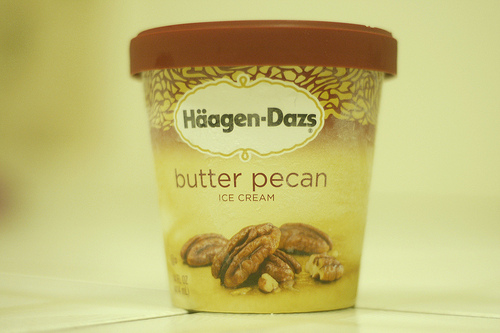
Introduction
I typically don’t eat Haagen-Dazs ice cream, but since it was buy one get one free I decided to try their Butter Pecan flavor, which was one of the lower sugar choices in their lineup. It’s not that there is anything wrong with this brand per se, but Haagen Dazs feel very generic to me in that it has been around as far as I can remember and isn’t marketed as being particularly healthy or different. I guess being around since 1961 you could call it a ‘classic’ ice cream company. Having said that, I’ll try to put aside my biases aside when reviewing this product.
Flavor
This ice cream tastes like your typical butter pecan, except that it it has a very strong cream flavor. I’ve made ice cream myself and used a large proportion of heavy cream (which contains 36%-40% milk fat) and it tasted similar.
My problem with this product is monotony – in both appearance and flavor. The brown pecans set against the plain white aren’t particularly visually appealing, but more importantly the flavor of the thick, creamy base isn’t different enough from the sweet pecans (which aren’t exactly crunchy), and as a result I get tired of eating this ice cream quickly. To put it another way, this ice cream lacks balance between two opposing flavors and textures. If I was tasked to improve the flavor, first I’d make the base lighter, possibly adding some other mild flavor and natural food coloring. Then I’d add more pecans, using larger ones if they exist, and possibly removing or reducing the butter from the pecans. Yes, I realize this would make the flavor less “butter pecan”, but the butter flavor and the cream flavors are too close for my taste.
Nutrition/Ingredients
In a 100 gram serving there is 300 calories, slightly higher than the average of other Haagen Dazs ice cream products I’ve looked at, but very high if you compare to some other companies such as Talenti and So Delicious desserts. Sugar content is a bit below average with 17 grams per serving
There is a nice portion of protein with 5 grams per serving, but the fat per serving (22 grams) is off the chart – its literally the highest I have seen in recent memory and helps to explain why the flavor is so heavy. I checked a few other brands and their versions of butter pecan all had less fat, with Bryer’s butter pecan containing less than half fat per serving (roughly 10 grams). Personally, I value overall number of calories more than fat content, but as I mentioned those are quite high as well.
The full list of ingredients are: cream, skim milk, sugar, skim milk (lactose reduced), pecans (pecans, coconut oil, salt, butter [salt, cream]), corn syrup, egg yolks, salt, vanilla extract
In spite of my problems with high calories, fat, and taste, the ingredients in this ice cream are actually quite healthy, as least as far as ice creams go. There are no preservatives, no artificial colorings, no artificial flavorings, or even natural flavorings. In fact, there aren’t any thickening agents such as guar gum either. Though I don’t consider this latter category to be necessarily unhealthy, I almost always prefer less ingredients, especially ones that are not everyday items I would use in the kitchen.
Some may spot “corn syrup” and associate that with “high fructose corn syrup”. While its true they are both made from corn, plain “corn syrup” contains more glucose as opposed to fructose, which is sweeter. While there is some research showing high amounts of fructose are harmful to the body if consumed frequently, some people maintain that these sugars all have similar effects on the body. After all, fruits naturally contain fructose (as well as gluctose and fructose), and table sugar is roughly half glucose and fructose.
Price/Availability
This sells all over but typically can be bought at Publix for around $4.69.
Ratings: Flavor: 5.0 Nutrition/Ingredients:7.5 Price:8.0 Overall: 6.8
Summary
A high-fat, high-calorie ice cream with reasonable ingredients that is worth a try for fans of butter pecan, but I found its heavy cream flavor a little too much.
References
http://www.haagendazs.com/Products/Product/2449
http://candy.about.com/od/candybasics/a/creamguide.htm
http://nutrition.about.com/od/grainsandcereals/f/fructosesyrup.htm

So Delicious Coconut Milk German Chocolate Frozen Dessert – product review

Introduction
I’m a proponent of all type of ice creams, including soy, coconut, and even goat milk-based. I’ve previously reviewed one of Luna Larry’s Coconut Bliss products (here), and this time I decided on reviewing another brand’s coconut frozen desserts that is soy free and dairy free.
I’ve had real German chocolate cake, as well as Cold Stone Creamery’s ice cream of the same flavor, and enjoyed both immensely. Unintentional or not, I’ll be comparing this to those products.
Flavor
To be honest, the first time I tasted this frozen dessert, I was a bit disappointed with the flavor. But when I tried it again the next day, it tasted much, much better. It took a mighty effort of willpower to stop myself from eating 2/3rds of the carton in a matter of seconds. From this I deduced two possible reasons for the difference in enjoyment. The first is that I was tired, not to mention on a full stomach, so my body was rejecting the ice cream. The other reason is that maybe it took my taste buds two tries before it “got” the flavor and learned to appreciate it fully. In any case, I’ll try to sample something on two separate days before I complete my review, whenever possible.
The appearance of this ice cream isn’t too appetizing, at least when compared to Cold Stone’s version (see references section below for a nice picture of the latter). The nuts are small and their color blends in with the chocolate so they don’t stand out. The coconut shavings are also few and far between, and blend into the chocolate and caramel base.
However, as you gradually start to shovel spoon after spoon into your mouth (of course after letting it partially melt) your doubts start to disappear. Rich chocolate swirled with sweet caramel, coconut shavings that tickle the tongue, and crunchy pecan pieces that entertain the teeth – its all there. There is no brownie as with the Cold Stone version, but the flavor is comparable and there is approximately 200 less calories and half the sugar.
If you take a deep whiff you’ll notice the coconut smell stands out, with a slight overtone of the caramel. There is little to no chocolate scent as cocoa is used in relatively small proportion compared to the coconut and caramel ingredients.
Nutrition/Ingredients
This product has 180 calories in a single 85 gram serving, slightly lower than the average of equivalent milk-based creams. Its also slightly higher than some of the other flavors of So Delicious coconut milk.
Sugar content is 14 grams per serving, which is typical for other coconut based frozen desserts, but quite low compared to many milk-based creams. I’m always amazed with the apparent sweetness of coconut-based products given their low sugar content. Its probably because agave syrup is commonly used, which is roughly 1.5 times sweeter than table sugar due to a high concentration of fructose. I’ve mentioned in a previous post that agave is potentially healthier than table sugar, but keep in mind that is still unproven and it may turn out that there is no difference from a nutritional point of view.
There is only one gram of protein in contrast to the relatively high fiber (6 grams of fiber which is 24% DV). I believe most of this comes from the chicory root extract which is high in fiber. Vitamins and Minerals, as listed on the package, are negligible except 6% of Iron.
Here is the full list of ingredients:
ORGANIC COCONUT MILK (WATER, ORGANIC COCONUT CREAM), ORGANIC AGAVE SYRUP, ORGANIC DRIED COCONUT, CHICORY ROOT EXTRACT, CARAMEL SAUCE (ORGANIC TAPIOCA SYRUP, WATER, MOLASSES, PEA PROTEIN, NATURAL FLAVORS, ORGANIC COCOA BUTTER, SODIUM CITRATE, SALT, CARRAGEENAN), PECANS, COCOA (PROCESSED WITH ALKALI), CAROB BEAN GUM, GUAR GUM, NATURAL FLAVOR.
Sodium citrate is used for flavor and also to regular acidity, and carob bean gum and guar gum are both used as thickeners to control texture. I’ve been seeing this in many of the products I’ve reviewed lately, but “natural flavor” is always a bad thing to me due to lack of transparency.
Carageenan, a substance extracted from seaweed, is used to thicken and stabilize the dessert. While it is generally accepted by the FDA as a food additive, some experts advise against using it in infant formulas, and some scientific research had indicated there is a possibility it can promote cancer. However these results were done with tissue cultures as opposed to directly with human subjects, and they are disputed by the scientific community.
I feel that the most nutritious ingredient in this dessert, by far, is the coconut itself – in the form of coconut milk and dried coconut. Though I am skeptical on those who claim coconuts are a “superfood” or one can live purely off them, there is a large number of vitamins and minerals in them: potassium, phosphorous, iron, zinc, folate, and manganese, among many others. There is also a large number of health benefits claimed, including raising good cholesterol, helping the immune system, and promoting heart health. (Check out the links I have provided in the references section for a starting point on researching coconut’s potential benefits.) I don’t think there is enough evidence to be 100% certain of many of these supposed benefits, but from the point of view that a wide variety of foods are good for health I feel it is wise to include some coconut in your (ice cream) diet.
On a final note, I’d like to mention a word of caution about how much nutrition coconut actually contributes to this product. While “coconut milk” is listed first on the label, and hence highest in proportion that other ingredients, coconut milk itself consists of water and coconut cream, with water in higher proportion. From this all that we can determine is that the coconut milk is at most 50% coconut cream, possibly much less. That would actually put the amount of coconut cream used less than other ingredients, such as agave which is listed second.
Price/Availability
I picked this up at Whole Foods Market for around $4.99 on sale, whereas it usually sells for $5.99.
Ratings: Flavor: 8.0 Nutrition/Ingredients:7.5 Price:7.0 Overall: 7.5
Summary
This frozen dessert combines the potential health benefits of coconut with a reasonable amount of sugar and calories, not to mention an unforgettable flavor that makes it one of my favorite coconut-based ice creams.
References
http://sodeliciousdairyfree.com/products/coconut-milk-frozen-desserts/german-chocolate
http://www.coldstonecreamery.com/icecream/signaturecreations/germanchokolatekake/index.html
http://www.myfitnesspal.com/food/calories/cold-stone-creamery-german-chocolate-like-it-852207
http://inrfood.com/ingredients/419
http://en.wikipedia.org/wiki/Carrageenan
http://www.nutrition-and-you.com/coconut.html
http://healthism.blogspot.com/2011/07/vitamins-and-minerals-in-coconut.html
http://authoritynutrition.com/top-10-evidence-based-health-benefits-of-coconut-oil/

Talenti Chocolate Coffee Chocolate Chip – company response on caffeine content and natural flavors query
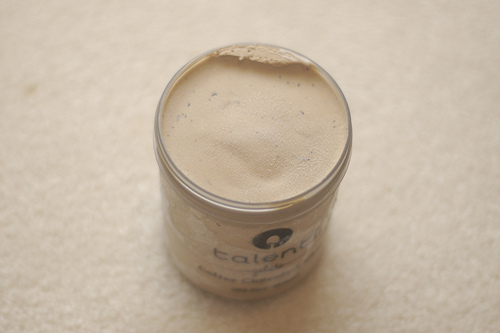
I had previously reviewed Talenti’s Chocolate Coffee Chocolate Chip ice cream, which maintains first place for my most loved ice cream. In that post I discussed sending an email to the company requesting more information about this product, and since I received a response from them I decided to write it up as a new post. The original blog post is here for those interested.
I had requested two things from them: caffeine amount and detailed explanation of “natural flavors”. The former was because I had felt quite a ‘kick’ from eating this and wanted to determine whether that was from sugar, caffeine, or something else. I asked the latter from my uneasiness as to what I am actually eating. It’s apparently ‘natural’ but what is it really? Consumers who want to research more about the possible side effects and nutrition of this catch-all ingredient are at a loss.
First I’ll give an excerpt of the polite email I received from Talenti, followed by my comments on it.
===
Thank you for the inquiry. We do understand your concerns regarding “natural flavors’ in our ingredients.

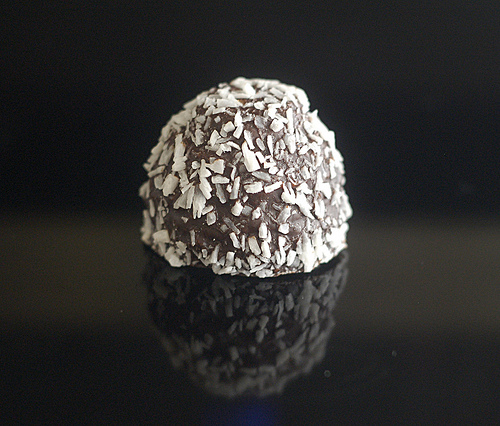
Ikea chocolate oat ball with coconut sprinkles (SÖTSAK KAKAOBOLL) – product review
Introduction
[Note: I have taken a break from this blog to focus my energies on my new blog, which is about learning Japanese language. Please check it out here if you are interested: http://selftaughtjapanese.com ]
This one of the rare times where I tried a product without any prior knowledge of its ingredients or nutritional information. These chocolate balls were sitting on display (openly without packaging) in Ikea’s cafeteria, and I couldn’t help myself from tasting one.
I was very delighted by this unique confection and have made a habit of having one every time I visit this wonderland of furniture stores.
I’ll set the tone for this review with an an excerpt of marketing material I received from Ikea.
“In a coffee-loving country like Sweden, the “fika”, or coffee break, is a treasured part of the day. And Swedish fika traditions hold that coffee should be served with seven small cakes and sweet biscuits.”
Flavor
The first time I picked up these chilled chocolate balls I was surprised at its weight, hinting at the massive amount of delicious things packed inside.
There is a strong sweetness and rich chocolate flavor, but the complex texture of this product is what really makes it so special. I struggle to find a way to describe its hearty composition. It’s almost like someone dug deep into the earth and pulled out a crumbly chunk of slightly oily, chocolaty soil, When you chew through the middle of the ball there is sort a gritty sensation which is a treat for the jaw, somewhere between crunchy and chewy. There’s also a strong chocolate scent to complete the taste experience.
At the time I had no idea how they crafted this magnificent texture, but when I read through the ingredients later I discovered that oats where the main contributor, with help from wheat flour, egg powder and baking soda. Irrespective of the nutritional value of this product, I consider this a masterpiece of cookie design.
If you take big bites you’ll polish off one of these in no time. Try to nibble small morsels one at a time for maximum enjoyment.
The coconut sprinkled on the outside of the ball added little to the taste or texture. I even broke off a piece of the crumbly inside, without the outer layer of chocolate coating and coconut rasp, but it tasted the same. To be fair, without the coconut sprinkles I think the appearance of the product would be naked and bland. If nothing else it hints at the texture inside.
The only thing preventing me from giving this a perfect flavor score is that the taste is so rich, its difficult to enjoy more than one in a sitting. It does go perfect with milk, however.
Nutrition/Ingredients
Each ball weighs in at 40 grams and packs 195 calories. For a small desert that’s quite a punch, but the calories/weight ratio is comparable to other similar candies. Take Ferrero Rocher’s Hazlenut chocolates where one serving (three balls) contain 220 calories for 41 grams. There are 13 grams of sugar which is reasonable for this type of product (compare to 15 grams in the same Hazlenut chocolates). Regardless of these figures, If I was trying to cut down on calories and sugar, I would pick Rocher’s product because the smaller ball size, with less density of ingredients, means I can spend more time enjoying them.
There isn’t much nutrition here, with only 2 grams of fiber and protein, and practically no vitamins or minerals. That’s OK with me, since I don’t expect much nutrition for a dessert of this type.
When I had first discovered this product in Ikea’s restaurant, I didn’t realize it was also sold in packs of six, so I sent an email to the company requesting ingredient information. After a little persistence, I finally got the detailed list which I’ll excerpt here unmodified:
Oat flakes (27 %), margarine (vegetable oils, water, salt, emulsifier [E471], natural flavouring, antioxidant [E330]), sugar, chocolate flavoured coating (12 %) (sugar, vegetable oil, fat reduced cocoa powder [15 %], emulsifier [soya lecithin], stabilizer [E492]), crumbs (sugar, oats [25 %], margarine [vegetable oils, water, salt, emulsifier (E471), antioxidant (E330), natural flavouring], wheat flour, egg powder, raising agents [E500ii, E450i, E503ii]), inverted sugar syrup, coconut rasp (2.5 %), fat reduced cocoa powder (1.6 %), flavouring, colour (E150a), water, preservative (E202). May contain traces of milk and almonds.
Its nice that 27 % of this product is oat flakes. Unfortunately there are several ingredients I try to avoid – margarine, flavoring (one is ‘natural’ while the other is likely artificial), an antioxidant (citric acid), preservative (potassium sorbate) and coloring (caramel color, class I – the least risky of the four classes).
With practically no nutrients and a handful of potentially harmful ingredients, this product should never be eaten for the purpose of nourishing the body.
Price/Availability
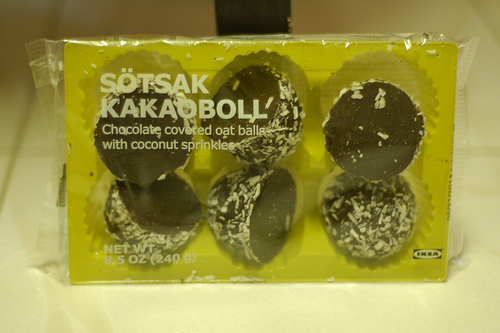
These chocolate balls are sold in Ikea stores as singles (for roughly $1.00 each) and in packs of six for $2.29.
I am considering making a homemade version of these chocolate balls myself someday, so I was very delighted to find that Ikea has a free handout available which contains a recipe for this product. Surely it will not taste exactly the same, but it has less ingredients and will likely be much healthier. This is probably the first time I’ve seen a store do this (except for places like Publix which stand to make a profit from ingredient sales) and I’m very impressed Ikea went out of their way to do this.
Ratings: Flavor: 9.0 Nutrition/Ingredients:5.0 Price:8.0 Overall: 7.3
Summary
A delicious, unique desert which should be sampled once by any sweet tooth. Be careful about getting addicted since it lacks nutrition and contains several suspicious substances.
References
http://www.ikea.com/us/en/catalog/products/20229025/

Do you believe in Nutrition?

In this blog I’ll occasionally discuss nutritional advantages or disadvantages of certain foods, but I’d like you to take those types of statements with a grain of salt. In fact, I think you should avoid taking any matters about nutrition too seriously, even if it comes from a doctor, scientist, or other professional.
Why?
The more I learn about nutrition, the more I feel that nobody really knows how good or bad things are for your body. That includes both long- and short-term effects, such as the chance of developing diseases or living longer as a result of a certain diet.
I’ll give a few of the reasons I feel this way. See if you agree.
To begin with, our understanding of the human body is still in its early stages and very limited. This is evident by the innumerable number of medical cases where the cause of the malady is unknown and a process of trial-and-error is used for treatment. This sometimes results in the patient being cured, but other times it ends in failure, or even worse, harm to the patient. This is true even for relatively simple physical systems such as the heart and lungs, but when it comes to the brain our knowledge is even more limited to the point we are just beginning to understand the secrets of the inner workings of this magnificent organ.
Now, don’t get me wrong – I’m not trying to disparage doctors or the medical community at large. On the contrary, I think every one of them is doing an amazing job, trying their best to make each and every patient’s life that much better. Even acknowledging that some doctors enter the field because of its potential for a high income, I’m impressed by anyone who can withstand the mental and physical challenges of this honorable job.
Another reason I don’t take nutritional information too seriously is that there is too many contradictory studies. Taking wine as an example, it has been shown to be linked to higher good cholesterol, help the heart, fight obesity, and help prevent stroke. At the same time it has also been connected to ailments such as migraine headaches, breast cancer, reflux, and chronic liver disease. Is wine good for the body or not? Even assuming every one of these studies is valid, it is unclear if my overall chances to live longer are better or worse as a result of drinking wine. Who is going to want to help their heart if it also increases their chances of liver disease?
Cholesterol is another matter where there is very differing opinions in the community on whether it causes heart disease or not. Blue food coloring, which was previously banned in many countries, is now legal in most of those same countries. Even for something as simple as everyday table salt, there are still debates raging on whether it really causes heart disease or not. And these few cases are just a tip of the iceberg of indecisive nutrition science.
It’s also very instructive to take a detailed look at some of the studies that claim a certain food is either bad or good for the body. Take an example I researched recently, the sweetener Sucralose, better known as Splenda. There are many articles online stating this product is bad because (among other things) a experiment on rabbit babies caused many more of them to die when compared to a control group that wasn’t given Splenda. On the surface this sounds horrible and can make the casual reader vow to never touch this product again.
But if you look deeper into the actual experiment, you find this news reports are very misleading. First, the rabbits were given roughly 450 times the recommended daily intake of Splenda. Clearly if a rabbit (or human) was given the recommended daily intake (450 times less) the effects would be much less, if present at all. Second, the experimenters noted that several of the deaths were caused by complications of the tubes used to feed the subjects. Furthermore, they found many of the negative reactions only occurred with only rabbits, not with mice, dogs, or rats. I’m not trying to say I’m convinced that Splenda is safe for consumption after all, but rather that there is still much room for debate on both sides.
How about vitamin C? Something that is touted to have a major effect on preventing colds and is added to so many products must have a strong scientific foundation, right? Not quite – a recent meta analysis of 72 studies on vitamin C’s effect on the prevention and reduction in length of the common cold determined that “The failure of vitamin C supplementation to reduce the incidence of colds in the general population indicates that routine vitamin C supplementation is not justified”. The study did find some scenarios where vitamin C’s effects were more apparent, such as subjects who were exposed to short periods of extreme stress, but that alone doesn’t warrant recommending it for everyone. So much for all those products which proudly announce “100% of daily value of Vitamin C!”
So what is the reason for all this indecisiveness? Besides the fact that the human body is such a complex thing and that all bodies are not made alike, in modern capitalist societies nearly everyone has an agenda. Food and drink producers want to make money, so they fund researchers to help ‘prove’ their product, or some ingredient used within, is healthy. If the results of the research are positive, they publish them and improve their chances of convincing the public to buy the product. But if things don’t turn out in their favor, they simply don’t release the information outside of their company. This is called the “file drawer effect” and adds a major bias to research without anyone outright lying.
What about those research results that prove a certain food is unhealthy? Surely, those are published by more morally minded, fair sources.
I doubt it.
The companies producing health foods without certain ingredients benefit from studies which prove those substances are unhealthy. Health-oriented supermarkets, such as Whole Foods Market, also have a stake in the game. There is also a plethora of health magazines, books, and news outlets which make money off any interesting or dramatic research. Note I didn’t include “accurate” here as a condition. Of course, I can’t speak comprehensively for all researchers, but I’m sure there is a great deal of bias on both sides of the nutritional debates.
Another example that had me fooled until recently was “evaporated cane juice”. I had seen this listed on several “health foods” in place of normal sugar and for quite some time I felt great that I was putting healthy, natural sugar in my body, as opposed to the evil, unprocessed stuff. But I happened to stumble on some articles that discussed how this ingredient was nearly the same thing, with negligible nutrients. In spite of a recommendation of FDA for companies to not using this misleading term, Chobani did so and was apparently sued by several people in California. Again, I’m not saying this is clear cut one way or the other – feel free to investigate yourself and see what evidence you can find.
The difficult of measuring long-term effects further complicates things. Even assuming a study is ideally designed and carried out, it would take at least 20 to 30 years to find out true long term effects. Nobody wants to wait that long to find of whether their favorite candy has detrimental long-term effects on the body. Also, for a study of that scale it must be very challenging to keep the number of variables small and the amount of data from getting out of hand. Do you think it would be easy to force two groups of people over several decades to eat the exact same diet with just one difference (i.e. use added salt or not)? That would be the only way to know for certain the effects of that change, notwithstanding various statistical methods used to extract the influence of a single variable when many are present.
To be fair, there are some things that have been proven conclusively to have major negative effects on the body – hard drugs, tabacco, and alcohol to name a few. But even in some of those cases (alcohol being one), there don’t appear to be any drastic effects if done in moderation. The bigger problem with all these substances is that they can be addictive, and the more frequent your intake is the higher your chances of damaging your body (or worse).
But most nutrition just isn’t that black or white – especially for small doses. So if you plan to enjoy an occasional pint of ice cream, don’t feel like you need to stress out over the ingredients. Its only for those that are addicted to sweets where it makes more sense to carefully analyze what your eating.
Did you learn anything? Feel a little different about nutrition? I hope if nothing else you have been motivated to call into question your fundamental stance on nutrition.
If you are convinced about the uncertainty of modern nutrition, the next question is what do do about it? Some may decide to just give up caring at all, and eat whatever they want. Others could try and read every published study, analyzing them and making their own decisions about nutrition – but doing that exhaustively would take an insane amount of time, and require some heavy scientific and medical background knowledge. Finally, you can just pick sources to trust, Dr. Oz or whomever that may be, and make nutritional decisions based on that information.
Just like other life decisions where things aren’t black or white, you’ll probably make decisions partially on emotion, partially on logic, and partially on logic. You’ll believe in your own way.
So – after saying all this, why do I even focus on nutrition in this blog? Shouldn’t I just give it up completely due to lack of clear direction on nutritional guidelines?
As I mentioned in my first post, my background is such that I like to think through things logically like a scientist, and enjoy very much picking apart a dessert ingredient by ingredient, looking up studies and opinions on each. Regardless of what you happen to believe about nutrition, I feel that nutritional transparency is very important. If consumers are not aware of what is in the food they are eating they can’t even begin the debate on whether those are healthy or not. That’s why I still am vehemently against “natural flavors” and anything that is not well-defined. I may choose to munch on some particularly (supposedly) unhealthy sweets, but I want to do it with full knowledge of what I’m putting into my body.
The process of learning about nutrition, and most other topics for that matter, is never ending. I’m still discovering new things day by day, inputting new information and always ready to change my beliefs.
References
http://www.foodandhealing.com/articles/article-cholesterol.htm
http://en.wikipedia.org/wiki/Brilliant_Blue_FCF
http://www.salon.com/2013/05/27/is_salt_really_so_bad_for_your_health_partner/
http://www.medscape.com/viewarticle/779063
http://www.npr.org/blogs/thesalt/2012/10/18/163098211/evaporated-cane-juice-sugar-in-disguise


 Sweets Reporter